What Is a Seed Phrase? Crypto Recovery Phrases Explained

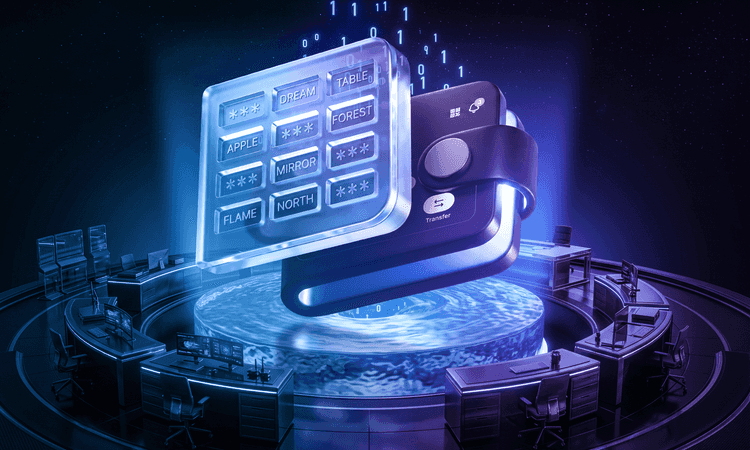
A seed phrase is a list of 12 or 24 ordinary words that a crypto wallet generates when you first set it up. Those words encode the master key to the wallet, so anyone holding them can restore it, and every asset in it on any compatible device.
What is a seed phrase?
A seed phrase, in short “seed,” is 12 or 24 words that your wallet generates the first time you set it up. Some also call it a recovery phrase or mnemonic phrase. These words are actually generated by a large (pseudo-) random number that the wallet and all the underlying software understands. Using seed phrases the wallet can recover, or generate, all your private keys, hence addresses, associated with that seed phrase at once.
Nobody can memorize a raw string of hex characters. Twelve or twenty-four ordinary words, in the exact order shown, does the same job and is something you can actually write down, or if you are smart enough, memorize. The order matters as much as the words themselves.
What a seed phrase looks like
A twelve-word seed phrase can look like the following: 1. mimic 2. employ 3. bronze 4. spike 5. deny 6. lawn 7. asthma 8. model 9. robot 10. bacon 11. resource 12. sweet
Note that even a small change in the words or their orders creates a totally new batch of private keys, or may even be invalid. For example, in the phrase above, if you change the place of 'deny' and 'spike,' it becomes invalid, and no wallet can create related private keys for it.
A 24-word seed phrase can look the same, with twelve more words.
WARNING: Do not use the seed phrase above. It is publicly written and totally unsafe.
How does a seed phrase work?
A seed phrase is generated by a seed phrase generator using a global algorithm amongst all wallets and all chains that agreed to use it. A generator does not pick word in a way that a random word generator would. Instead, it has a specific, checksummed algorithm for word-picking to make sure everything stays secure and universal.
The BIP39 standard and the 2048-word list
Before diving into that specific algorithm we should get familiar with a Bitcoin Improvement Proposal (BIP), called "Mnemonic code for generating deterministic keys." BIP39 proposed a human-readable way for key generation to easily create and remember your "keys" for every wallet on Bitcoin. Later, every chain integrated this way to create their own wallets.
They proposed a 2048-word list to pick over for every key-generation. Why 2048?
- The most important reason is that it was enough. We never needed more words to make sure everything is secure. I encourage you to do the math to see how secure it is.
- The algorithm was designed to cut a pre-generated entropy into 11-bit chunks, and each chunk represented the index of the word in the list, hence 2^11 = 2048 (which look like a loop definition).
Important: Although proposed in the Bitcoin environment, your seed phrase isn't a Bitcoin thing, or in other words "chain-specific thing." It's the root of every chain your wallet touches, so a leaked phrase doesn't cost you one asset on one chain, it costs your entire cross-chain footprint in one move.
From words → seed → private keys → wallet addresses
Now, let's see the seed phrase generation algorithm:
-
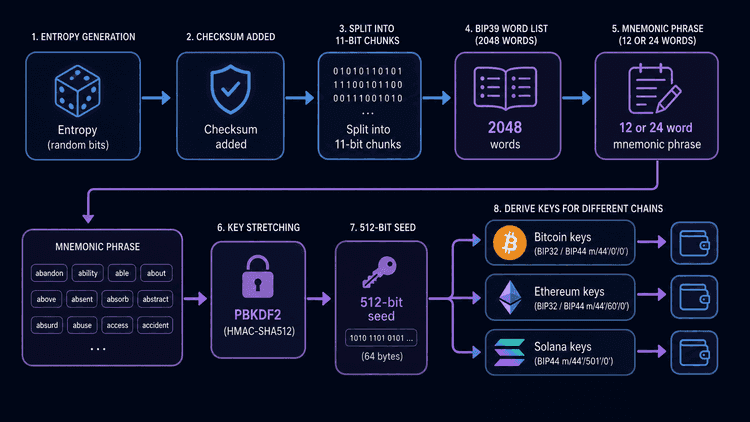
The wallet generates a random number, typically 128 or 256 bits, using a cryptographically secure (pseudo-) random number generator. This is called entropy. More entropy means a longer phrase: 128 bits produces 12 words, 256 bits produces 24. Longer phrases lead to more security; although it makes it harder to remember.
-
A hash of that entropy is appended to it. This is called checksum. Checksum makes sure that a typo or a corrupted phrase did not happen on import instead of silently deriving the wrong wallet.
-
The combined bits are split into 11-bit chunks, as mentioned before. Each chunk is an index into the BIP39 word list. Chunk by chunk, the phrase is assembled.
-
That phrase goes through a key derivation function, to produce a 512-bit seed.
-
Using that 512-bit seed, a tree of private keys is generated for each blockchain. This process is standardized by BIP32. It is done in chain abstraction-friendly derivation paths, so the same 12 (or 24) words control your Bitcoin, Ethereum, Solana, and other Virtual Machine (VM) addresses without you memorizing three separate phrases.
Why misspellings and wrong word order break it
After the entropy is picked, a hash of the entropy is attached to it as its checksum. A checksum is part of almost all parts of our lives, from our social security numbers to our bank card numbers and even in phone numbers in some countries. A checksum makes sure that a given number is correctly formatted and has no misalignments. Now, if you reorder the words, the hash of it changes and the checksum would not be valid. Also, a misspel makes the misspelled word not present in the 2048-word list, hence not valid again.
Seed phrase vs private key: What's the difference?
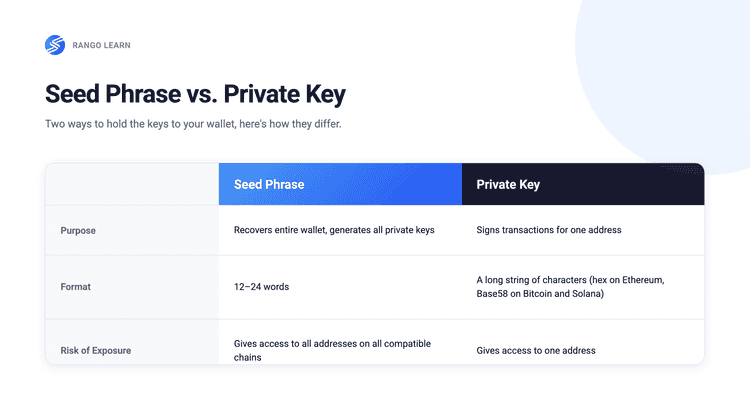
Unlike seed phrases that can unlock and recover all private keys of all blockchains at once, private keys can only control one address on one blockchain, or better explain, one VM. You cannot use a private key of a Bitcoin wallet address to control anything on Ethereum or Solana. But all EVM chains like Ethereum, Polygon, BNB Chain, and Arbitrum share the same private key and address pattern. Specifically, a seed phrase sits one level above the private key. It's the master input that deterministically regenerates every private key. Show a wallet the phrase, and it recreates the exact same set of keys and addresses, in the same order, every time.
Losing one private key costs you access to one address, and if that address was never funded, it costs you nothing. Losing a seed phrase costs you every address the wallet has ever generated, including ones you set up months ago and forgot existed.
Nobody legitimate will ever ask for your seed phrase Wallet supports, DeFi project supports, and all legitimate supports can ask for a public address or a transaction hash to diagnose a problem. It will never ask for your seed phrase or private key. Anyone who does is trying to scam you.
Why your seed phrase matters: self-custody in one sentence
Without access to recovery, self-custody is meaningless. Seed phrase is the “human way” of having recovery. Before BIP39 standardized this in 2013, wallet backups were raw private keys or unwieldy encrypted files, and a lot of early Bitcoin was lost to corrupted backups nobody could read years later.
Nowadays, people may lose their phones, break their laptops, or in the simplest way just switch or upgrade them to a newer version. Wallet providers know that and have a solution for it. The solution is the seed phrase to recover all your wallets at once; and it works across all different brands, chains, and infrastructures. A phrase generated in one BIP39-compatible wallet restores cleanly in a different one, which is part of why the standard won: it decoupled your funds from any single piece of software.
This easy portability of recovery makes every thief as happy as you are. Phishing sites, fake wallet apps, and malware built to scan for screenshots all target the seed phrase directly, because it's the one artifact that unlocks everything at once.
Can you use the same seed phrase in a different wallet?
In one word, yes. But there is a small catch. If the wallet uses the same BIP39 standard, everything goes smoothly and no problems occur. However, if that wallet uses another standard you might face some problems, including recovering totally different private keys or wrong seed phrase errors.
But, in the current cryptocurrency world, almost all wallets use the same BIP39 standard and while you are on the same chain, you get to see your funds on any wallet. This is what we call the derivation path. Think of your seed phrase as the front door to a skyscraper and the derivation path as the specific floor and apartment number where a coin lives. Different wallet software, networks or chains, or account standards (like Legacy vs. Native SegWit on Bitcoin, or multi-chain variations like Solana vs. Ethereum) often default to different path formulas. If your balance shows up as zero in the new wallet, your funds aren't lost; the new app is simply looking in the wrong room. Meaning that if you had funds on Bitcoin Legacy room, and the new wallet is suddenly opening Ethereum or Solana for you, you are just in a wrong room, and need to find that specific room to see you $BTC.
How should you store and back up a seed phrase?
Paper is good to write your seed phrase on. But obviously it is not durable. Fire, flooding, fading ink, and low paper quality have lost more assets than hackers have ever stolen anything. Some other forms are more durable, like a stamped metal plate. They survive fire and flooding, and most hardware wallet makers already sell them.
Another way that many people take, which is one of the worst ways, is to store their seed phrase digitally. You should know that storing in a way that is connected to the internet or can be hacked with a small physical access can put your seed phrase in extreme danger. That includes cloud notes, password manager entries, encrypted files on your laptop, and photos. Malware built specifically to scan devices for seed-phrase-shaped text is common enough that a "just this once" screenshot is a real risk.
Encrypting the phrase before uploading it doesn't really solve the problem, it just moves it. Your seed phrase is only as safe as the encryption key now guarding it, and that key has to be memorized or stored just as carefully as the original phrase was. You've added a step, not removed the risk.
A BIP39 passphrase, sometimes called a 25th word, adds a real separate layer. You can append your own extra word to the standard 12 or 24 derives an entirely different wallet from the same seed words. Your word is exclusive and private to you and can be any word you choose. Even if someone finds your 12 words, without the passphrase they reach an empty decoy wallet. The bad thing is if you forget your passphrase, you will lose your wallet as well.
Which wallets and projects use BIP39?
BIP39 is almost universal among non-custodial wallets. Hardware wallets like Ledger and Trezor use it, as do software wallets such as MetaMask, Trust Wallet, and Phantom. Multi-chain wallets rely on it specifically because BIP39, paired with BIP32 and BIP44 derivation paths, is what lets one phrase manage addresses on unrelated chains with completely different address formats.
Conclusion
A seed phrase is a checksummed, human-readable encoding of the one number that controls your entire wallet, across every chain it touches. Treat it accordingly: generate it offline, store it on something that survives a fire, split your backups, and never type it anywhere except a legitimate wallet you trust. For a multi-chain wallet, protecting that phrase is protecting all of it at once, not just the part you're currently looking at.
When you're ready to move assets across chains, Rango Exchange lets you connect your wallet and approve transactions without giving up custody of your seed phrase or private keys. Explore cross-chain swaps on Rango Exchange.
Resources and Further Readings
Frequently asked questions
Check out most commonly asked questions, addressed based on community needs. Can't find what you are looking for?
Contact us, our friendly support helps!
Is a seed phrase the same as a password in a wallet?
No. A password is chosen by you and can be changed if it leaks. A seed phrase is generated once, mathematically fixed to your wallet's keys, and cannot be changed without creating an entirely new wallet and moving your funds to it.
What happens if I lose my seed phrase but still have my wallet open?
You still have access for now, but you have no way to recover the wallet if the device is lost, damaged, or reset. Many wallet providers like MetaMask give you access to recover your seed phrase directly from your open wallet (if you know the password). But if you genuinely have no access, generate a new wallet, write down its seed phrase properly, and move your funds over while you still can.
Is my seed phrase or private key shared with Rango Exchange?
No. Your seed phrase and private keys remain entirely under your control. Rango never asks for, accesses, or stores your wallet credentials. You simply connect your wallet and approve transactions yourself, while Rango Exchange handles the swap and cross-chain execution.
What is a seed phrase example?
A 12-word seed phrase may look like this: 1. mimic 2. employ 3. bronze 4. spike 5. deny 6. lawn 7. asthma 8. model 9. robot 10. bacon 11. resource 12. sweet
NOTE: Don't use this publicly shown seed phrase for any of your wallets!
How do I get a seed phrase?
All wallet providers create a seed phrase for you, the first time you open them and follow their instractions. They give the seed phrase to you, and you must keep it safe, secure, and private.
What is the 12-word recovery phrase for Bitcoin?
A 12-word recovery phrase is the other name for a seed phrase. You can create it via your Bitcoin wallet, the first time you open it.
Is a seed phrase the same as a private key?
No! Seed phrase is a bunch of words that can create and recover many private keys and addresses accross many chains and standards. Private key can only sign a transaction for a specific address, on a specific chain.
Can I use one seed phrase for multiple wallets and multiple chains?
Yes. One seed phrase can create and recover many private keys and addresses accross many different chains wallets, as long as the wallet follows the BIP39 standard. Which most of them do!
Is a 24-word seed phrase safer than 12 words?
Yes. Much much much safer. But obviously, a bit harder to remember and keep secure and safe.
Can someone guess or brute-force my seed phrase?
The short answer is NO. But the long answer is a malicious person can try to do that but it probably take them hundreds of billions of years to find a specific seed phrase, if they are very lucky. My personal bet is on them taking trillions of years. As a small comparison, the age of Earth is estimated only ~4.5 billion years.
Do I need my seed phrase to swap or bridge tokens?
Short answer: No. You need a seed phrase to recover your private keys and addresses. Once you have them open on a wallet, you won't need your seed phrase to bridge or swap your tokens. You will only need your private key for signatures, which your wallet provider usually handles. If you need to swap or bridge your tokens in a fully self-custody manner, fastest and cheapest way to do it is through Rango dApp.