Bridge vs Swap in Crypto

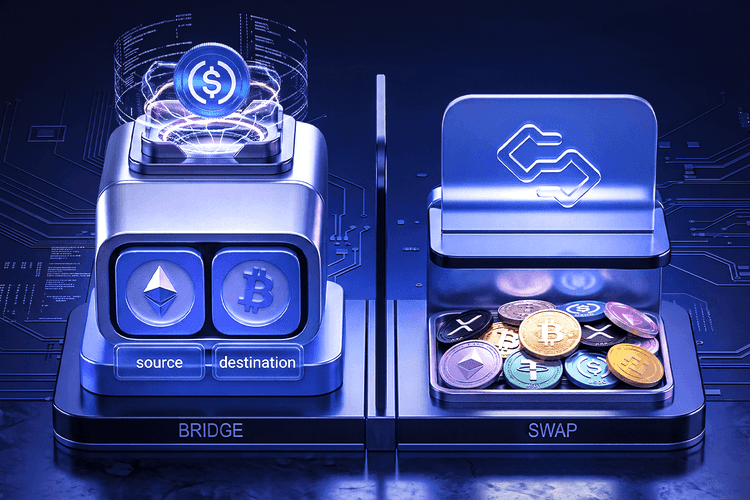
The terms bridge and swap are often presented beside the same transaction box, which can make them appear interchangeable. However, different outcomes are produced by each process. A crypto swap primarily changes the asset being held, while a bridge generally changes the blockchain on which an asset is available. This distinction becomes less visible when cross-chain aggregators combine several actions into one route. Read the full article below to understand how each transaction works, what risks are introduced, and which option may fit a particular cross-chain objective.
What Is the Difference Between a Bridge and a Swap?
The simplest explanation of the difference between bridge and swap is that a swap changes the token, while a bridge changes the token’s network. For example, exchanging USDC for ETH on Ethereum is a swap because the asset is changed without leaving Ethereum. Moving USDC from Ethereum to Arbitrum is generally considered a bridge because the asset is transferred between blockchain environments.
A crypto bridge connects otherwise separate blockchain networks and allows assets, messages, or data to be transferred between them. A crypto swap, by comparison, exchanges one token for another through available liquidity. However, the distinction can become less obvious when a cross-chain service converts the token and changes its network in the same transaction.
| Transaction Objective | Typical Action |
|---|---|
| Change USDC into ETH on Ethereum | Swap |
| Move USDC from Ethereum to Arbitrum | Bridge |
| Convert USDC on Ethereum into SOL on Solana | Cross-chain swap |
| Move the same asset across networks | Bridge |
| Receive a different asset on the same network | Swap |
What Is a Cross-Chain Swap?
A cross-chain swap changes both the asset and the blockchain within one coordinated workflow. For example, ETH on Ethereum may be converted into USDC on Base without requiring a bridge interface and a separate destination-chain DEX to be used manually. Under the surface, swapping, bridging, message passing, or liquidity settlement may still be required.
A cross-chain swap should therefore be understood as an outcome rather than a single universal mechanism. Some routes are completed through bridge liquidity, some through solvers, and others through a sequence of onchain swaps and transfers. The final user experience may appear to contain one action even though several protocol interactions are being coordinated.
How Cross-Chain Aggregators Route Transactions?
A cross-chain aggregator like Rango Exchange compares routes across **DEXs, bridges, liquidity networks, and supported blockchains. The input asset, destination asset, source chain, destination chain, expected output, fees, transaction time, and available liquidity are evaluated. A crypto bridge aggregator may focus primarily on asset-transfer routes, while a broader aggregator can combine onchain exchanges and cross-chain transfers.
For example, a route from USDT on BNB Chain to ETH on Arbitrum could be performed by swapping before the bridge, bridging an intermediate asset, and swapping again on the destination. Another route may be settled directly by a cross-chain liquidity provider. Rango describes its routing infrastructure as aggregating DEXs, bridges, and other aggregators for same-chain and cross-chain execution.
How Does a Crypto Swap Work?
A swap is usually executed through a liquidity pool or another onchain trading mechanism. In an automated market maker, or AMM (a smart-contract system that prices assets through liquidity reserves), the input token is deposited into a pool and the requested output token is released. The amount received is determined by pool liquidity, the size of the trade, protocol fees, and price impact.
A quote is normally rendered before confirmation. It may include the exchange rate, expected output, minimum received amount, network fee, route, and price impact. When the trade is large relative to available liquidity, a greater movement in the pool price can be produced. For this reason, the output shown for a DEX swap should be reviewed rather than only the displayed token price.
DEXs and DEX Aggregators
A decentralized exchange, or DEX (an onchain venue for permissionless token trading), provides access to one or more liquidity pools. A DEX aggregator searches multiple DEXs and liquidity sources before constructing a route. A single trade may be divided across several pools when a split route is expected to produce a better net output.
The highest quoted token amount is not always the most favorable route after gas and price impact are included. Aggregation is therefore used to compare executable outcomes rather than only headline prices. Access to several liquidity venues can reduce slippage in some conditions, although improvement cannot be guaranteed for every pair or trade size.
How Does a Crypto Bridge Work?
A cross-chain bridge transfers value or information between networks that do not communicate natively. Depending on the bridge design, tokens may be locked on the source chain while a corresponding representation is minted or released on the destination chain. Other systems use liquidity pools, burn-and-mint mechanisms, validators, relayers, or native asset-transfer protocols.
When users bridge crypto across chains, two separate network environments must be considered. A source-chain transaction is first confirmed, after which the destination-side release must be validated and completed. A delay can therefore be introduced by network finality, bridge verification, relayer performance, liquidity availability, or destination-chain congestion.
The received token should also be inspected carefully. A bridged representation may not have the same contract address, liquidity, integrations, or redemption pathway as a native token on the destination network. Asset continuity may be maintained economically, but technical equivalence should not automatically be assumed.
Bridge vs Swap: Fees, Speed, and Risks
In a crypto bridge vs swap comparison, fees should be evaluated by route rather than category alone. A same-chain swap may include network gas, a liquidity-provider fee, price impact, and an interface or protocol fee. A bridge may involve source-chain gas, bridge fees, liquidity or relayer charges, and, in some cases, destination-chain costs.
Speed is also conditional. A liquid same-chain swap may be completed after one network confirmation, while a bridge must usually coordinate state across at least two networks. However, a liquidity-based bridge or solver route may occasionally be faster than a congested same-chain trade. The displayed completion estimate should therefore be treated as an estimate rather than a guaranteed settlement time.
The risk surfaces also differ. Swaps are exposed to slippage, manipulated or illiquid tokens, malicious approvals, front-end spoofing, and smart-contract failures. Bridges add cross-chain verification, relayer, validator, custody, wrapped-asset, and destination-delivery risks. Academic reviews of bridge exploits have found that bridge systems can contain several interacting components, including contracts and offchain nodes, which expands the number of assumptions that must be evaluated.
When Should You Bridge or Swap Crypto?
The swap vs bridge decision should be based on the intended result. A swap is normally selected when a different token is required on the current blockchain. A bridge is normally selected when the same or an equivalent asset is required on another blockchain. A cross-chain swap may be more suitable when both the token and network need to be changed. For example, when USDC is held on Ethereum but SOL is needed on Solana, a cross-chain route can replace the manual sequence of swapping, bridging, changing networks, and swapping again. The route should still be reviewed because simplicity at the interface does not remove the underlying protocol risks.
How to Bridge or Swap Crypto Safely?
When learning how to bridge crypto or how to swap crypto, the official application domain should first be verified. The source and destination networks, token symbols, contract addresses, wallet address, minimum received amount, price impact, approvals, and total fees should then be checked before signing.
A small test transaction can be conducted before the primary transfer. For example, a limited amount may first be sent through the selected route, after which the destination token and contract address can be validated in the wallet or block explorer. The larger transaction may then be submitted only after the route has been reproduced successfully.
Unlimited token approvals should be avoided when a limited allowance is sufficient. A destination gas balance should also be considered, since a bridged token may arrive without enough native gas to perform the next transaction. Seed phrases and private keys should never be entered into a bridge, swap interface, support form, or verification page.
Conclusion
The bridge vs swap crypto distinction is determined by the transaction outcome. A swap changes the asset, a bridge changes the network, and a cross-chain swap changes both within a coordinated route. DEX aggregators improve access to onchain liquidity, while cross-chain aggregators compare more complex combinations involving exchanges, bridges, and settlement systems. No route should be selected only because it contains fewer visible steps. Expected output, fees, token contracts, security assumptions, destination liquidity, and recovery options should also be examined. Small, reversible tests are generally favored before large transfers, while transaction previews should be read whenever the exposure is meaningful.
Frequently asked questions
Check out most commonly asked questions, addressed based on community needs. Can't find what you are looking for?
Contact us, our friendly support helps!
Is Bridging the Same as Swapping?
No. A crypto swap exchanges one token for another, while a bridge moves an asset between blockchains. For example:
Some platforms combine bridging and swapping into one route, but the underlying actions remain different.
Should I Bridge or Swap Crypto?
A swap should be used when a different token is needed on the same blockchain. A bridge should be used when the same asset needs to be moved to another network. When both the token and blockchain must change, a cross-chain swap may be more suitable. Before confirmation, the expected output, fees, destination network, and token contract should be reviewed.
Can Crypto Be Swapped Across Blockchains?
Yes. A cross-chain swap can convert an asset on one blockchain into another asset on a different blockchain. The route may combine a DEX swap, a bridge, liquidity providers, or solvers. Although the process may appear as one transaction, several steps can be executed underneath. A small test transaction is generally recommended before transferring a large amount.