
What Are Solver Networks?


It is increasingly observed that decentralized trading systems are shifting from explicit transaction construction toward outcome-based execution. Instead of manually routing swaps through multiple liquidity sources, a desired result is expressed and executed by competing solver networks. This architectural shift becomes especially relevant in fragmented multi-chain environments, where liquidity is distributed across rollups and settlement paths are non-trivial. A key behavioral change is introduced: execution is no longer fully defined by the user but partially inferred and optimized by external agents.
What Is a Solver?
A solver is an execution agent that attempts to fulfill a user intent under optimal conditions. Instead of directly interacting with an AMM (automated market maker), a solver receives a goal such as token conversion or cross-chain transfer and computes a viable execution path. It is commonly observed that solvers are operated by professional market makers or infrastructure providers with access to external liquidity inventories. Execution quality is influenced by their ability to source liquidity across multiple venues and chains.
Solver networks are execution layers in decentralized finance where third-party agents compete to fulfill user-defined outcomes. These outcomes are expressed as intents rather than explicit transaction steps. Execution is then outsourced to specialized participants who optimize routing, pricing, and settlement across liquidity venues. This structure is increasingly used in modern DEX aggregation and cross-chain infrastructure.
Solvers Explained
Solvers can be interpreted as competing optimizers in an auction-based environment. Each solver attempts to propose a settlement path that satisfies the intent at the best possible price or outcome. In systems like CoW Protocol, multiple solvers may submit competing solutions for the same batch of orders, with only the most efficient solution being executed.
Why Solvers Matter?
The introduction of solvers reduces the need for manual routing across fragmented liquidity environments. Improved execution quality is often observed in cross-chain swaps where direct routing would otherwise require multiple bridging and swap steps. Reduced slippage and improved price discovery may occur under competitive solver conditions, although results vary depending on liquidity depth.
Solvers vs Market Makers
Market makers traditionally provide liquidity by quoting bid-ask spreads directly into order books or AMMs. Solvers, however, operate as execution coordinators rather than passive liquidity providers. While market makers supply liquidity, solvers compete to determine how that liquidity is accessed and routed. A key distinction is that solvers may incorporate multiple market makers, bridges, and liquidity sources within a single execution plan, whereas traditional market makers operate within a narrower scope of execution.
How Solver Networks Work?
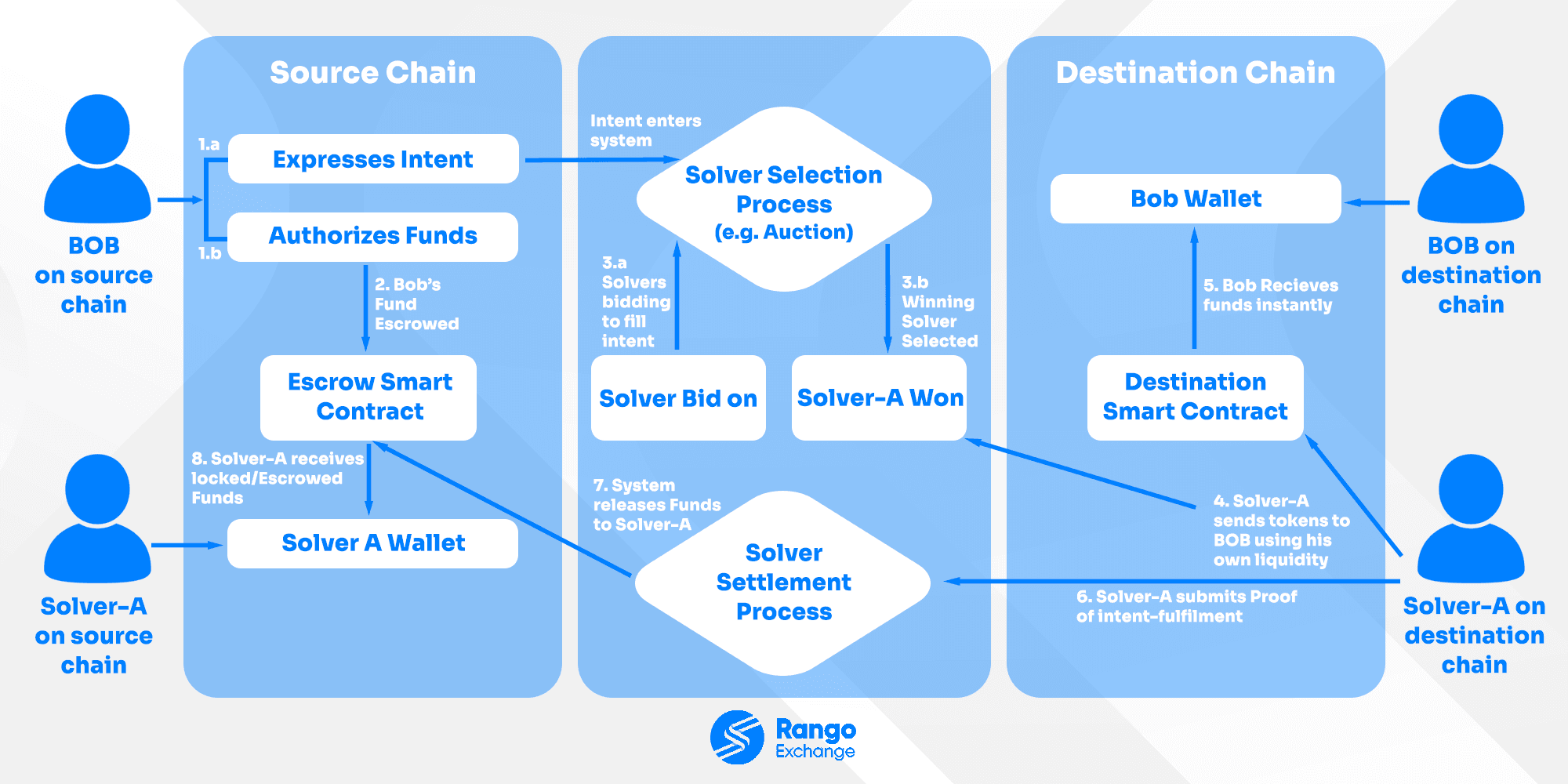
Solver networks operate through a sequence of intent submission, competition, and settlement. A user-defined intent is broadcast to a solver pool, where competing agents attempt to construct the most efficient execution path.
It is often observed that execution quality depends on both solver diversity and liquidity availability. Under high competition, better pricing outcomes tend to be produced, while under low competition, execution may default to suboptimal routes.
User Intents
User intents represent declarative transaction goals. Instead of specifying “swap token A for token B via pool X,” the intent specifies the final desired outcome. The system then determines how the result is achieved.
Solver Competition
Competition between solvers acts as the core optimization mechanism. Each solver evaluates available liquidity, gas conditions, and routing efficiency before submitting a solution. The best solution is selected for execution, often through auction-based mechanisms.
Best Execution
Best execution refers to the selection of the optimal settlement path based on price, slippage, gas efficiency, and routing complexity. It is frequently influenced by solver competition intensity and available cross-chain liquidity.
What are Intents?
Intents are structured outcome-based transaction definitions where only the final result is specified, while execution logic is delegated to external solver systems. Instead of prescribing detailed routing steps, the intent defines constraints such as asset input, desired output, and execution boundaries.
It is commonly observed that intents are transmitted as signed messages interpreted by solver networks. These solvers then evaluate multiple execution paths across liquidity venues and bridges before submitting a settlement candidate. This abstraction reduces user complexity while increasing reliance on external execution optimization. A key behavioral shift is introduced: execution certainty is no longer strictly deterministic but depends on solver competition, liquidity depth, and real-time market conditions.
Intent Swaps
Intent swaps describe token exchanges where only input and output conditions are defined, while routing is fully abstracted. Instead of selecting pools or bridges manually, execution is dynamically constructed by solvers. It is often observed that solvers combine liquidity from AMMs, market makers, and cross-chain bridges into a single execution path. Because routing is recalculated in real time, identical intents may result in different execution outcomes under varying network conditions.
Outcome Constraints
Outcome constraints define the execution boundaries within which solvers are allowed to operate. These typically include minimum received amount, maximum slippage tolerance, and optional timing restrictions. Tighter constraints tend to reduce solver participation due to lower profitability margins, while looser constraints increase competition but may introduce higher variance in execution quality. In practice, these constraints function as feasibility filters for solver bids.
Intent Settlement
Intent settlement refers to the final stage where a solver’s execution path is validated and committed on-chain. The intent is resolved into one or more transactions that update blockchain state. In cross-chain systems, settlement may occur asynchronously, with intermediate bridging steps and delayed finality depending on network conditions. A solver’s submitted bundle is verified against constraints before final execution is accepted by smart contract logic.
How Solver Auctions Work?
Solver networks commonly rely on auction-based coordination mechanisms to determine how user intents are executed. Instead of processing transactions sequentially through fixed routing logic, competing solvers attempt to construct the most efficient settlement path under current market conditions. It is frequently observed that auction design directly affects execution quality, settlement latency, and MEV exposure. Some systems operate through continuous real-time bidding, while others aggregate orders into discrete auction windows where competing solutions are evaluated simultaneously. A key advantage of this structure is that routing competition occurs before execution is finalized on-chain. This allows liquidity fragmentation across chains and venues to be optimized externally before settlement occurs.
Bidding Systems
Bidding systems allow multiple solvers to submit competing execution proposals for the same intent. Each proposal typically contains routing logic, estimated output amounts, gas assumptions, and execution cost calculations. It is commonly observed that solver profitability is determined by the spread between execution efficiency and operational cost. Solvers therefore compete to discover routes that satisfy user constraints while remaining economically viable. Under volatile market conditions, bid quality may fluctuate rapidly due to changing liquidity depth and gas pricing. As a result, execution estimates presented initially may later diverge slightly before settlement finalization.
Order Auctions
Order flow auctions aggregate multiple intents into a shared execution environment where solvers compete over grouped transaction batches rather than isolated swaps. This aggregation allows opposing flows to be internally matched before external liquidity is accessed. For example, a user selling ETH for USDC may be matched against another participant buying ETH with USDC, reducing external routing requirements and lowering slippage exposure. Batch-based systems such as CoW Swap frequently rely on this mechanism. It has been observed that auction batching may improve price efficiency, although short execution delays are sometimes introduced while competing solver bids are collected.
Winning Routes
Winning routes are selected according to optimization criteria such as best execution quality, gas efficiency, settlement reliability, and slippage minimization. A solver’s route may include several coordinated components simultaneously, including AMM routing, bridge selection, liquidity aggregation, and inventory rebalancing. The final selected path is executed once protocol validation confirms that all user-defined constraints are satisfied. In practice, the most profitable route for the solver is not always identical to the best route for the user. Auction rules are therefore designed to align solver incentives with execution quality as closely as possible. Under low competition environments, however, pricing efficiency may deteriorate relative to highly contested auction conditions.
Why Solvers Improve UX?
Solver systems are primarily designed to reduce execution complexity for end users while improving settlement quality through competition.
Solvers and Cross-Chain Swaps
Cross-chain environments represent one of the most important deployment areas for solver networks because liquidity is heavily fragmented across rollups, sidechains, and Layer 1 ecosystems. Instead of requiring users to bridge assets manually before executing swaps, solver systems increasingly combine bridging and trading into a unified execution flow.
It has been observed that operational complexity rises significantly when transactions span several execution domains simultaneously. Gas funding requirements, bridge selection, settlement timing, and liquidity discovery must all be coordinated under changing network conditions. Solver infrastructure is designed to abstract much of this complexity away from the user-facing layer.
A broader architectural shift is therefore visible: cross-chain execution is gradually evolving from sequential user-managed actions into outcome-based settlement systems.
Cross-Chain Intents
Cross-chain intents allow desired outcomes to be defined across multiple blockchain environments simultaneously. Instead of specifying every intermediate step, users declare the final expected result while solvers determine how assets are routed between chains.
For example, an intent may specify that USDC held on Base should be converted into ETH received on Arbitrum within predefined slippage and timing constraints. The required bridge, liquidity source, and routing path are then selected dynamically during execution.
It is commonly observed that this abstraction reduces interface complexity substantially, particularly for less experienced users navigating fragmented ecosystems.
Unified Routing
Unified routing refers to the solver’s ability to combine bridging, liquidity aggregation, and swap execution into a single coordinated process. Rather than interacting with separate protocols sequentially, routing logic is consolidated internally before settlement occurs.
A solver may therefore source liquidity from multiple DEXs while simultaneously evaluating bridge costs, gas conditions, and settlement latency. The resulting execution path is optimized holistically rather than transaction-by-transaction.
In practical workflows, this reduces the number of approvals, confirmations, and manual route comparisons required from the user side.
Multi-Chain Execution
Multi-chain execution involves coordinated settlement across several blockchain environments and liquidity systems. Unlike single-chain swaps, execution may depend on asynchronous bridge confirmations, relayer activity, or delayed finality windows.
It has been observed that execution latency varies considerably depending on bridge architecture and network congestion. Optimistic systems may require challenge periods, while liquidity-network bridges may provide near-instant execution using pre-funded inventory models.
A small operational scenario illustrates this behavior clearly. A user intent may request ETH on Optimism while holding stablecoins on Ethereum mainnet. A solver can temporarily front liquidity on the destination chain, complete the swap locally, and reconcile the originating transfer afterward through bridge settlement infrastructure.
Although this abstraction improves usability, delayed settlement, bridge failure, and liquidity shortages cannot be ruled out entirely under stressed market conditions.
Risks of Solver Networks
Despite improving execution abstraction and reducing manual complexity, solver networks introduce additional dependency layers that can affect reliability, transparency, and settlement quality. Execution outcomes remain dependent on solver participation, liquidity availability, and auction competitiveness.
It is often observed that abstraction reduces direct user interaction while increasing reliance on external execution infrastructure. Under stressed market conditions, this dependency can expose several operational risks.
Solver ecosystems may gradually concentrate around a relatively small number of high-capacity participants with superior liquidity access and routing infrastructure.
As competition decreases, execution quality and pricing efficiency may become more dependent on a limited group of dominant solvers. This concentration can reduce transparency and increase systemic reliance on private execution networks.
Failed execution may occur when liquidity becomes insufficient, solver participation declines, or market volatility changes execution conditions faster than routes can be finalized.
Under cross-chain conditions, bridge congestion and delayed settlement finality may also interrupt execution flows. Small test transactions are therefore commonly recommended before larger transfers are initiated.
Although solver systems often reduce direct user exposure to MEV (maximal extractable value), MEV activity may still persist within solver infrastructure itself.
Private routing logic, execution ordering, and internal auction strategies can still influence settlement outcomes. As a result, MEV is frequently redistributed rather than fully eliminated.
Projects Using Solvers
Several major DeFi protocols now rely on solver-based execution models to improve routing efficiency, cross-chain settlement, and pricing quality. Although implementation details differ, most systems use competitive execution mechanisms where external participants fulfill user intents.
Conclusion
Solver networks represent a structural transition in decentralized trading architecture, where execution responsibility is increasingly delegated to competitive agents rather than directly encoded transactions. Improved execution quality, reduced interface complexity, and cross-chain abstraction are commonly observed outcomes under favorable conditions. However, this abstraction introduces dependency on solver competition, liquidity depth, and auction efficiency. Execution is therefore not deterministic in quality and may vary across market regimes. A conservative operational approach is typically favored, where small reversible tests are conducted and execution previews are carefully reviewed before larger transfers are initiated. A practical heuristic is often maintained: outcome abstraction reduces cognitive load, but increases reliance on external execution systems, making verification and incremental testing essential under uncertain conditions.
Resources
Frequently asked questions
Check out most commonly asked questions, addressed based on community needs. Can't find what you are looking for?
Contact us, our friendly support helps!
Are solver networks better than traditional DEX aggregators?
Solver networks can improve execution quality when liquidity is fragmented across several chains or venues. Instead of routing through a fixed path, competing solvers attempt to discover a more efficient settlement route based on liquidity depth, gas conditions, and available inventory. Better pricing and reduced manual interaction are often observed during cross-chain swaps or large trades. However, under highly liquid same-chain conditions, differences may become relatively small once gas fees and auction latency are considered. Execution quality also depends on the sophistication of participating solvers and the amount of accessible liquidity.
What is the difference between intents and swaps?
A traditional swap specifies the exact transaction path, including the token pair, liquidity pool, and execution sequence. An intent-based swap operates differently. A desired outcome is declared first, while routing and settlement decisions are delegated to external solvers. For example, a user may request a final amount of ETH on Arbitrum while holding USDC on Base, without manually selecting bridges or DEXs. The solver network then determines how the outcome can be achieved with the lowest cost or best execution under current conditions.
Can solver networks fail or produce bad execution?
Yes. Solver networks can still produce poor execution if available liquidity is insufficient or if no solver can fill a request efficiently. However, intent-based systems are designed to minimize these issues through competition between multiple solvers. Since route discovery and solver auctions occur off-chain, intent-based architectures offer strong MEV resistance, allowing users to receive more competitive pricing and often near zero slippage. Slippage tolerance itself is not controlled by the intent model and remains a user-defined transaction setting. Large trades may still experience price impact when liquidity is limited, but intent-based architectures can often execute them more efficiently than traditional routing systems. In practice, intent-based architectures can often handle larger orders more efficiently than conventional routing models by leveraging competitive solver liquidity and optimized execution paths.