Best Cross-Chain Bridges 2026


Cross-chain transfers are now used for moving assets between Ethereum, Layer 2 networks, Solana, and other blockchain ecosystems. However, the first route displayed by a bridge may not provide the fastest settlement or the highest final amount received. The best cross-chain bridges 2026 should therefore be evaluated by security, route coverage, asset type, fees, slippage, and execution model. This guide compares seven established bridges and aggregators for different transaction requirements.
Best Cross-Chain Bridges at a Glance
Cross-chain bridges are designed for different transaction types, so their strengths should be compared by route rather than by a single overall ranking. Some platforms are optimized for direct asset transfers, while others combine bridges, DEXs, solvers, or liquidity sources to complete more complex cross-chain swaps. The table below summarizes where each option is most useful and how its route is executed.
| Platform | Best suited to | Route model |
|---|---|---|
| Rango Exchange | Finding cross-chain swap routes | DEX and bridge aggregation |
| deBridge | Intent-based cross-chain transfers | Solver-filled orders |
| Across | Ethereum and Layer 2 bridging | Relayer-based execution |
| Stargate | Same-asset stablecoin transfers | Liquidity pools and OFT routes |
| Wormhole Portal | Solana and non-EVM transfers | Cross-chain messaging |
| Relay | Fast transfers and destination gas | Relayer-based execution |
| Circle CCTP | Native USDC transfers | Burn-and-mint mechanism |
A single platform cannot be classified as the best crypto bridge for every transaction. Direct bridges are often suitable when the source and destination assets are already known, while aggregators are more useful when several bridges, DEXs, or execution steps must be compared.
What Makes a Cross-Chain Bridge Worth Using?
A cross-chain bridge should not be assessed only by whether a transaction can be completed. The quality of a route is also determined by how the transfer is verified, what asset is delivered, how much is received, how quickly the transaction can be recovered if it fails, and which additional systems are introduced between the source and destination chains. A route that appears faster or cheaper may involve a less suitable security model, a wrapped asset with limited liquidity, or additional destination-chain actions. These conditions should be reviewed together before a bridge is selected.
Security Model and Bridge Risks
Cross-chain bridges can rely on validators, guardian networks, liquidity providers, relayers, solvers, issuer attestations, optimistic verification, or combinations of these systems. A validator or guardian model depends on a group of authorized participants to confirm cross-chain messages. An optimistic model assumes that submitted information is valid unless it is disputed during a defined verification period, while an issuer-attestation model depends on an authorized entity confirming that a source-chain action has occurred.
Each architecture creates a different trust surface. The number of signers, the signature threshold, the use of upgradeable smart contracts, the presence of administrator keys, the transaction-pause mechanism, and the process used to resolve invalid messages should therefore be examined. A large validator set may appear more decentralized, but the effective security level can still be reduced if only a small number of signatures is required or if a single administrator can upgrade the contracts.
Bridge risk should not be treated as theoretical. An academic analysis of 49 bridge attacks recorded between June 2021 and September 2024 identified incidents involving private-key exposure, fake cross-chain events, contract weaknesses, front-end compromise, and failures in cross-chain business logic. Another systematic study identified 12 potential attack vectors and grouped historical bridge attacks into 10 vulnerability categories. These findings indicate that risk can be introduced through contracts, off-chain infrastructure, privileged keys, message validation, and the application interface, not only through the underlying blockchains.
The safest crypto bridge should therefore be selected by asking several practical questions. It should be determined who can approve a message, how invalid messages can be challenged, whether assets are held in a contract, how contract upgrades are controlled, and what occurs if the destination transaction is delayed. Security audits and bug bounties may provide useful signals, but they should not be interpreted as guarantees.
Zooming in, a simple transaction habit is illustrative. Before a large transfer is initiated, a smaller test transfer can be completed through the same source chain, token, destination chain, and receiving address. The received token contract, execution time, and final balance can then be confirmed before the primary transaction is submitted. This procedure does not remove protocol risk, but address, asset, route, and interface errors may be detected while the exposed amount remains limited.
Supported Networks, Tokens, and Routes
A high number of displayed blockchain logos does not necessarily mean that every token, direction, or transaction size is supported. A bridge may support Ethereum and Solana while offering only a limited number of assets between them. Another protocol may support USDC from Ethereum to a Layer 2 network but not the reverse direction or a less liquid token on the same chains.
The complete route should therefore be checked rather than the chain count alone. The source blockchain, source token contract, destination blockchain, destination token contract, amount, wallet address format, and destination gas requirement should all be entered before a platform is evaluated. Minimum and maximum transfer limits may also apply, while low-liquidity routes can become unavailable or uneconomical at larger transaction sizes.
Rango Exchange is a cross-chain DEX and bridge aggregator designed to discover and compare transaction routes across a wide range of blockchain ecosystems. It supports major environments such as EVM networks, Solana, TON, TRON, Stellar, XRP Ledger, and Sui, as well as UTXO-based blockchains including Bitcoin, Litecoin, Dogecoin, Dash, and Zcash. Rango can also connect users to Cosmos-based chains and other blockchain environments through its integrated routing infrastructure.
For each transaction, Rango analyzes available DEXs, bridges, liquidity sources, and aggregators to provide a best-rate cross-chain route.
For example, moving USDC from Arbitrum to Solana may be handled as a same-asset bridge route when suitable liquidity is available. By contrast, moving ETH from Ethereum to SOL on Solana may require an Ethereum-side swap, a bridge or messaging step, and a Solana-side delivery. More execution steps generally create more approval surfaces, pricing dependencies, and possible failure points. The route preview should therefore show not only the named provider but also each intermediate asset and protocol.
Fees, Slippage, Speed, and Final Amount Received
Cross-chain bridge fees are rarely represented by one charge. The total cost may include source-chain gas, bridge or protocol fees, relayer compensation, liquidity-provider fees, destination-chain gas, price impact, and slippage. Slippage is the difference between the expected execution price and the price obtained when the transaction is completed.
Across, for example, separates destination gas costs, relayer capital costs, and liquidity-related fees. Relayers provide their own destination-chain capital and wait to be reimbursed, so the time value of that capital can be included in the quote. The fee displayed by a protocol should therefore be interpreted as one component of the transaction rather than the complete economic cost.
The cheapest crypto bridge is better identified by comparing the final amount received. A route charging a $1 protocol fee may still be less efficient than a route charging $3 if an additional $8 is lost through price impact, destination gas, or an unfavorable intermediate swap. The quoted output, minimum amount received, estimated time, and required number of transactions should be reviewed together.
Speed should also be measured carefully. A fast destination fill does not always mean that final settlement has occurred. In relayer-based systems, the asset may be delivered quickly while reimbursement and protocol settlement are completed later. In other designs, additional source-chain confirmations or message attestations must be obtained before the destination transaction can be executed.
Quote freshness is another practical consideration. Gas prices, bridge liquidity, solver availability, and token prices may change between quote generation and wallet confirmation. Some quotes contain timestamps or expiration conditions, and Across requires its fee quote timestamp to remain close to the current source-chain time. A stale quote should be refreshed rather than repeatedly submitted after its original conditions have changed.
Native Assets vs Wrapped Tokens
A native asset is issued directly on the destination blockchain by the relevant protocol or authorized issuer. A wrapped token is a representation of an asset whose backing is held, locked, or otherwise controlled on another blockchain. Although both assets may display a similar name or symbol, they can have different contract addresses, liquidity levels, integrations, and risk assumptions.
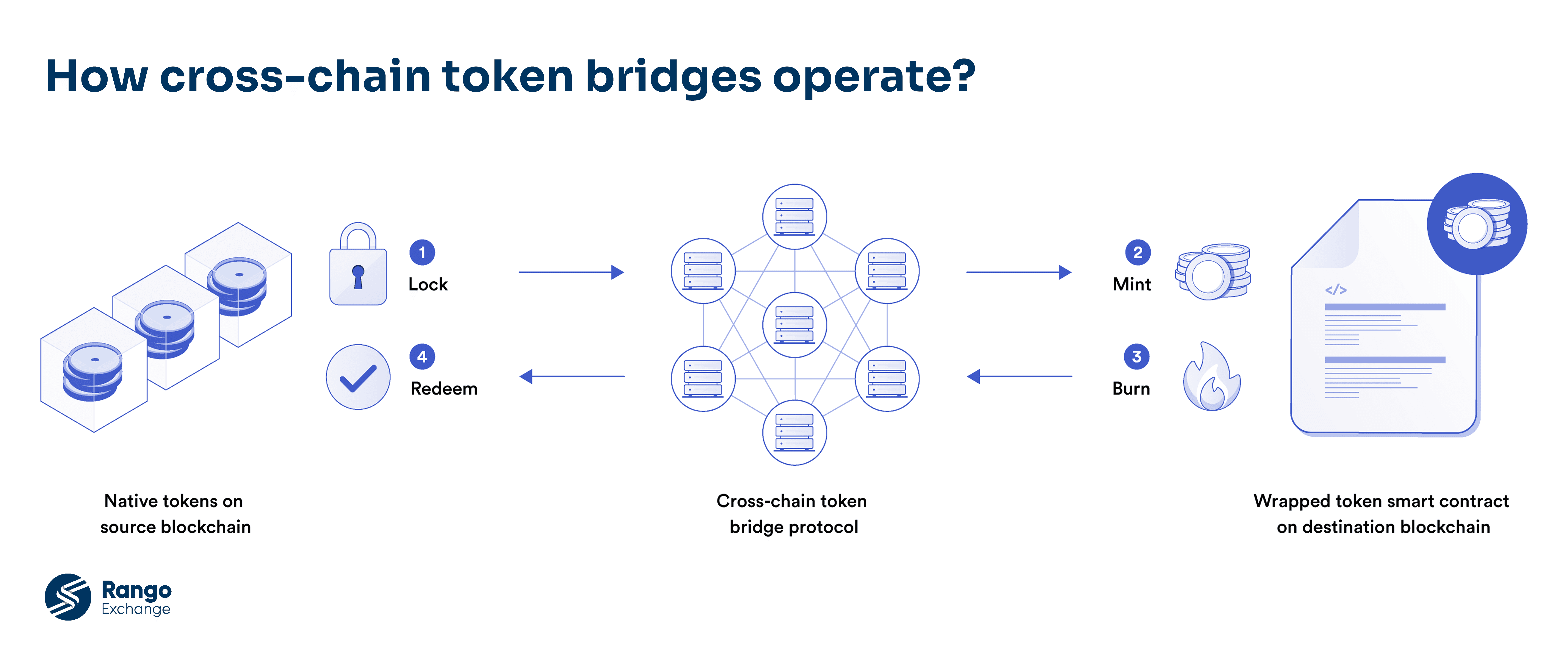
Circle CCTP moves USDC through a native burn-and-mint process. USDC is burned on the source blockchain, a message is attested, and an equivalent amount of native USDC is minted on the supported destination blockchain. Traditional bridge liquidity pools and a permanent wrapped-USDC representation are therefore not required for the transfer itself.
Wormhole Wrapped Token Transfers use a different model. Tokens can be locked on the source chain and represented by wrapped tokens minted on the destination chain. During a return transfer, the wrapped representation can be burned and the original asset can be released. Wormhole also provides Native Token Transfers as a separate framework, so the asset model should be identified for the specific route rather than inferred only from the Wormhole name.
The distinction matters after the bridge transaction has been completed. A wrapped token may not be accepted by the intended DEX, lending market, wallet, or payment application, even when its ticker resembles the native asset. Liquidity may also be fragmented across several versions of the same token.
Before confirmation, the destination contract address should therefore be compared with the contract recognized by the intended application. The asset’s name, symbol, decimals, issuer, and available liquidity should also be reviewed. When meaningful value is being transferred, receiving the correct asset representation can be more important than saving a small amount in bridge fees.
7 Best Cross-Chain Bridges and Aggregators in 2026
Rango Exchange: Best for Finding Cross-Chain Swap Routes
Rango operates as both a cross-chain DEX aggregator and a cross-chain bridge aggregator. Instead of relying on a single bridge or liquidity source, it searches across multiple DEXs, bridges, and routing protocols to identify suitable execution paths based on the selected assets, networks, expected output, and transaction costs.
This broader aggregation model is particularly valuable when a transaction involves both a token conversion and a change of blockchain. For example, converting BTC to USDC may require moving value from the Bitcoin network into stablecoin liquidity on a smart-contract blockchain such as Ethereum, Arbitrum, Solana, Base, or BNB Chain. Depending on the selected destination, the route may combine cross-chain infrastructure, liquidity sources, and destination-chain execution within a single flow.
Rango has processed approximately $9 billion in volume with no exploit or user-fund-loss history. With multiple audits, support for 50+ key chains, real-time route simulation, and long-standing wallet integrations, it stands out as a reliable cross-chain swap aggregator.
deBridge: Best for 0-TVL Cross-Chain Swaps
deBridge routes cross-chain orders through the deBridge Liquidity Network, where users define the desired output and independent solvers provide liquidity on the destination chain. Its 0-TVL architecture does not rely on shared protocol liquidity pools; liquidity is instead supplied on demand by competing solvers.
This model makes deBridge particularly useful for flexible cross-chain swaps without exposing capital to permanent bridge pools. However, execution availability and pricing can depend on whether solvers find a specific route and order economically attractive.
Across: Best for Ethereum and Layer 2 Bridging
Across is primarily designed for fast cross-chain execution across Ethereum, Layer 2 networks, and other supported chains. A relayer provides the requested asset on the destination chain and is reimbursed after the transaction has been verified and settled.
The transaction lifecycle is divided into initiation, destination fill, and settlement. This model can reduce the time users wait to receive funds, although route availability, gas costs, and final output should still be compared before signing.
Stargate: Best for Cross-Chain Stablecoin Transfers
Stargate V2 is mainly designed for same-asset bridging. For example, USDC on one supported network can be transferred into USDC on another supported network rather than being converted into a different token.
Taxi mode is used for immediate execution, while Bus mode batches several transactions to reduce gas costs. A lower-cost Bus transfer may involve a longer waiting period, creating a direct trade-off between cost and speed.
Wormhole Portal: Best for Solana and EVM Networks
Wormhole Portal is commonly considered when assets must be moved between Solana, EVM networks, and other supported blockchain ecosystems. Token transfers are connected to Wormhole’s cross-chain messaging infrastructure.
Wrapped Token Transfers use contracts that can lock, burn, mint, or release tokens depending on the selected route. Because a wrapped asset may be received, the destination token contract and available liquidity should be confirmed. These capabilities make Wormhole a notable best bridge for Solana candidate, although the appropriate route depends on the asset being transferred.
Relay: Best for Fast Transfers and Destination Gas
Relay is focused on rapid cross-chain execution through relayers. Every transfer begins with a quote containing the expected fees, transaction data, and required execution steps.
Destination gas can also be added to supported transfers. A small amount of the destination network’s native gas token may be delivered alongside the bridged asset, allowing another transaction to be completed without first acquiring gas separately. Relay may therefore be considered when the fastest crypto bridge experience and immediate destination-chain usability are prioritized.
Circle CCTP: Best for Native USDC Transfers
Circle Cross-Chain Transfer Protocol is designed specifically for native USDC movement. USDC is burned on the source blockchain and an equivalent native amount is minted on the destination blockchain after the required attestation has been produced.
Traditional bridge liquidity pools and wrapped USDC representations are not required. This makes CCTP a strong best bridge for USDC candidate when both the source and destination networks are supported. Fees may depend on whether Standard Transfer, Fast Transfer, or forwarding services are selected, so a current fee quote should be obtained before execution.
Which Cross-Chain Bridge Is Best for Your Transaction?
Best Bridge for Ethereum and Layer 2 Networks
Across is suitable for many Ethereum-to-Layer-2 and Layer-2-to-Layer-2 transfers because destination funds can be delivered by relayers before final settlement. A canonical bridge may still be preferred when the official chain pathway and its settlement model are specifically required.
Best Bridge for Solana Transfers
Wormhole Portal is suited to transfers involving Solana and several external blockchain ecosystems. Rango may be more practical when a Solana transfer also requires the source or destination token to be swapped.
For native USDC routes supported by Circle, CCTP should also be compared because wrapped USDC may be avoided.
Best Bridge for USDC and Stablecoins
CCTP provides a direct native-USDC mechanism where supported. Stargate can be considered for same-asset stablecoin transfers, while Across may provide a fast relayer-filled route.
The final decision should be based on native-asset delivery, total cost, execution time, and the amount guaranteed by the quote.
Best Option for Swapping Different Tokens Across Chains
A cross-chain DEX aggregator is generally more useful when both the token and blockchain must be changed. Instead of completing separate swaps and bridge transfers manually, Rango can search across integrated DEXs, bridges, and liquidity sources to build a single-step/multi-step routes.
For example, converting BNB on BNB Chain into SOL on Solana may involve a source-chain swap, a bridge transfer, and delivery on Solana. Before confirming the transaction, users should review the intermediate tokens, total fees, slippage, estimated time, and minimum amount received. The route offering the best final output, not simply the lowest displayed fee, should usually be preferred.
Cross-Chain Bridge vs Bridge Aggregator: What Is the Difference?
A direct bridge provides transfers through one protocol and one primary execution model. A bridge aggregator compares or combines several bridges, DEXs, and liquidity sources.
Users searching for terms such as “Bridge crypto” may encounter both categories, although they perform different functions. A direct bridge can provide a simpler and more auditable path. An aggregator can provide broader coverage and may find a route when no single bridge supports the complete transaction.
How to Compare Fees and Routes?
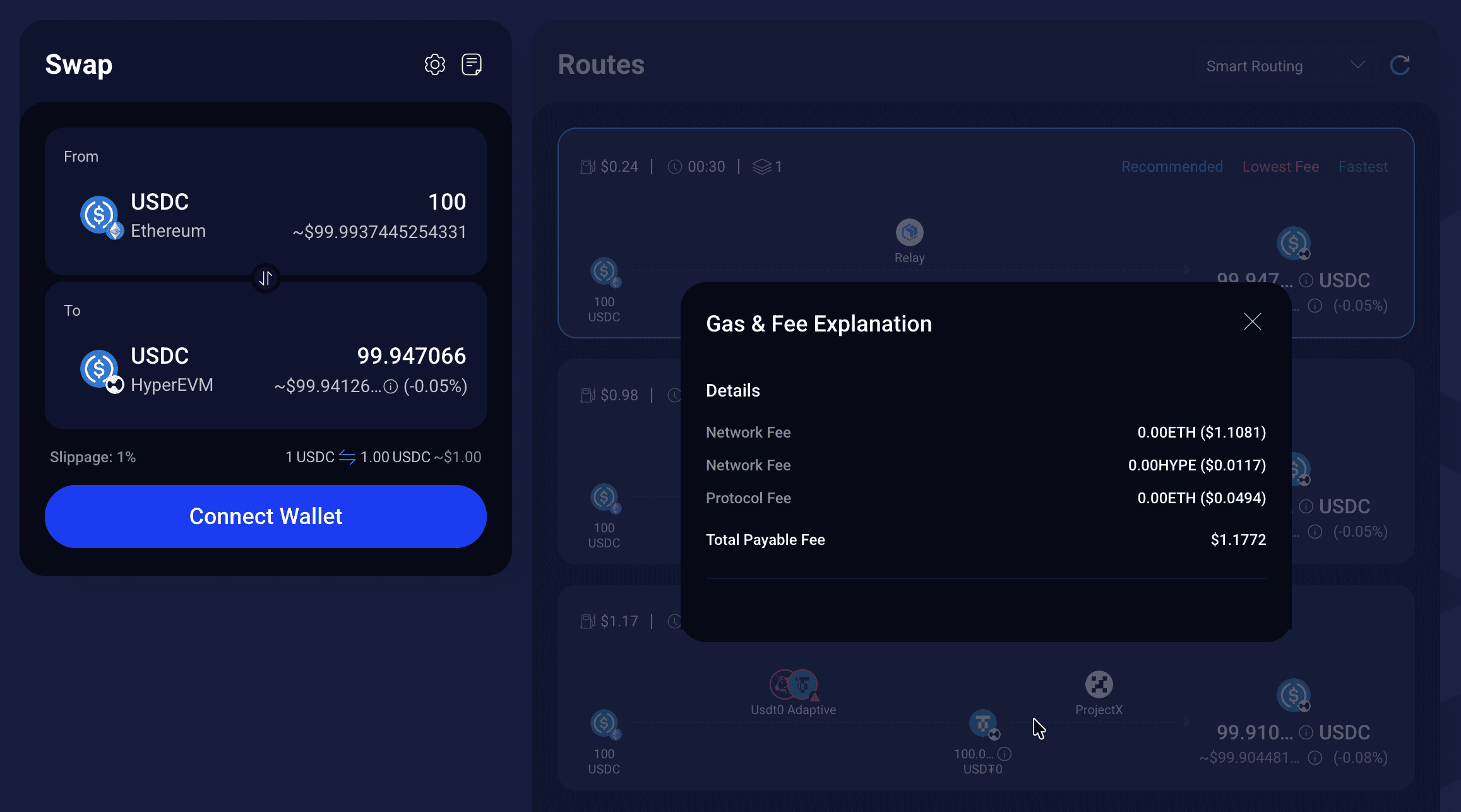
Routes should be compared using the full fee breakdown, not only the advertised bridge fee. In a live Rango quote, users can review source-chain gas, network fees, price impact, destination-chain costs, minimum amount received, required approvals, and estimated execution time.
A practical quote screenshot can show how these costs are distributed across each step of the route, including any intermediate assets or protocols involved. Since gas prices, liquidity, and solver availability can change, the quote should be refreshed immediately before signing.
How to Bridge Crypto Safely?
The official application domain should be verified before a wallet is connected. The source network, destination network, token contract, recipient address, approval amount, minimum received, and estimated fees should then be reviewed.
A small transfer should be completed before the primary amount is submitted. Unlimited token approvals should be avoided unless their implications are understood, and transaction hashes should be retained for troubleshooting. When wrapped tokens are received, their official contract address and destination-chain liquidity should be confirmed before further use.
Conclusion
The best cross-chain bridge depends on the transaction rather than a universal ranking. CCTP is designed for native USDC movement, Wormhole for Solana connectivity, Stargate for same-asset transfers, Across for Ethereum and Layer 2 execution, deBridge for solver-based orders, and Relay for fast fills and destination gas.
The challenge is knowing which option is best for a specific route at a specific moment. Rango addresses this by comparing integrated bridges, DEXs, and liquidity sources in real time, then presenting routes based on final output, speed, or fees.
For users who do not want to compare each protocol manually, an aggregator provides a practical way to evaluate multiple options under the hood and select a route based on their priorities at the time of execution.
Resources
Frequently asked questions
Check out most commonly asked questions, addressed based on community needs. Can't find what you are looking for?
Contact us, our friendly support helps!
How long does a cross-chain bridge transfer take?
A cross-chain transfer may take from a few seconds to several minutes, while some routes can take longer during congestion or when additional confirmations are required. Transfer time depends on the source and destination networks, bridge design, relayer or solver availability, and settlement method. The estimated completion time and route status should be reviewed before confirmation.
Which cross-chain bridge has the lowest fees?
No bridge consistently provides the lowest fees across every network, asset, and transaction size. Source and destination gas, liquidity-provider fees, relayer costs, slippage, and price impact should all be considered. Rango compares quotes from integrated bridges, DEXs, and liquidity providers in real time, helping users identify low-cost routes while maximizing the expected amount received. The final output should therefore be prioritized over the advertised bridge fee alone.
Is a cross-chain bridge aggregator better than a direct bridge?
An aggregator is often more useful when several routes must be compared or when different tokens are being swapped across chains. It can combine DEX and bridge steps into one route. A direct bridge may be preferable for a known same-asset transfer when a simpler route with fewer protocol dependencies is desired.