MetaMask vs Trust Wallet

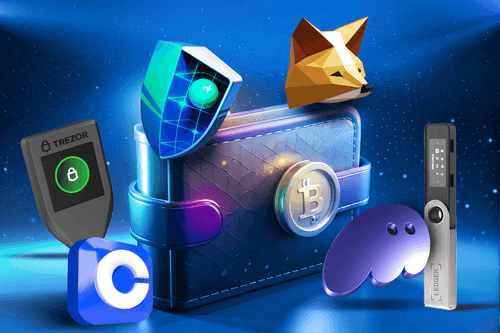
MetaMask and Trust Wallet are both self-custody wallets, meaning users retain control of their private keys rather than relying on an exchange. Their practical strengths still differ, however. MetaMask offers broad multi-chain support while remaining especially strong for browser-based DApp interactions and advanced Web3 workflows. Trust Wallet focuses more on mobile-first portfolio management and native access to a wide range of blockchain networks. The comparison below examines their network support, fees, security features, and the workflows each wallet handles most effectively.
What Is MetaMask?
MetaMask is a self-custody crypto wallet available as a browser extension, mobile app, and web interface. It was built around Ethereum and EVM networks (blockchains compatible with the Ethereum Virtual Machine), which is why it remains a common connection option across DeFi protocols. In 2026, the MetaMask wallet also supports native Bitcoin, Solana, and TRON, alongside Ethereum assets and custom networks. Swaps, bridging, buying, selling, staking, lending, and DApp signing can be accessed through the wallet and MetaMask Portfolio.
What Is Trust Wallet?
Trust Wallet is a self-custody wallet provided through iOS and Android apps and a browser extension. Its main distinction is native multi-chain coverage, with support advertised for more than 100 blockchains, including Bitcoin, Ethereum, Solana, BNB Chain, TRON, and TON. Private keys are encrypted locally on the device, while swaps, staking, NFTs, DApps, and limit orders are surfaced inside the same interface. In practical terms, it is a mobile-first wallet for managing assets across many unrelated ecosystems.
MetaMask vs Trust Wallet: Key Differences
The main MetaMask vs Trust Wallet difference is not simply feature count. It is how each product prioritizes browser interaction, chain coverage, and portfolio management.
| Area | MetaMask | Trust Wallet |
|---|---|---|
| Main Strength | Ethereum, EVM DeFi, and browser DApps | Mobile use and native multi-chain management |
| Platforms | Extension, mobile app, and web | Mobile app and browser extension |
| Networks | EVM-focused, plus BTC, SOL, and TRON | More than 100 native networks |
| Swaps | Aggregated swaps and bridge routes | DEX-routed swaps and limit orders |
| Staking | Mainly ETH and selected services | Wider native staking selection |
These platform, network, and feature details reflect official documentation available in July 2026.
Supported Networks and Assets
Trust Wallet retains the broader native network range and generally requires fewer manual network additions. MetaMask has also evolved into a multichain wallet, with native support for Bitcoin, Solana, TRON, and major EVM networks, alongside custom network options. The practical difference is now less about EVM versus non-EVM support and more about workflow: Trust Wallet emphasizes broad, mobile-first asset management, while MetaMask combines multichain portfolio support with strong browser-based DApp connectivity and transaction controls.
Mobile App, Browser Extension, and DApp Access
Both wallets provide mobile and extension-based access, but DApp discoverability differs. MetaMask is frequently shown as a direct connection option by Ethereum and EVM applications, which reduces friction on desktop. Trust Wallet also supports browser and mobile DApp access while keeping assets from many chains within one portfolio. The practical distinction is therefore browser-native DeFi depth versus broader multi-chain convenience, rather than desktop versus mobile availability alone.
Swaps, Staking, and Cross-Chain Features
MetaMask and Trust Wallet both use liquidity aggregation to route swaps across decentralized exchanges and supported cross-chain providers, including routes powered by Rango Exchange. MetaMask Swaps focuses on finding competitive routes across its supported networks, while Trust Wallet also offers slippage controls and limit orders for selected assets. Their staking experiences differ as well: MetaMask primarily emphasizes ETH and selected staking services, whereas Trust Wallet provides native staking for a broader range of assets. Behind these swap experiences, aggregators compare available liquidity sources, fees, slippage, and execution routes to identify the best available output for the user at that moment.
MetaMask vs Trust Wallet Fees
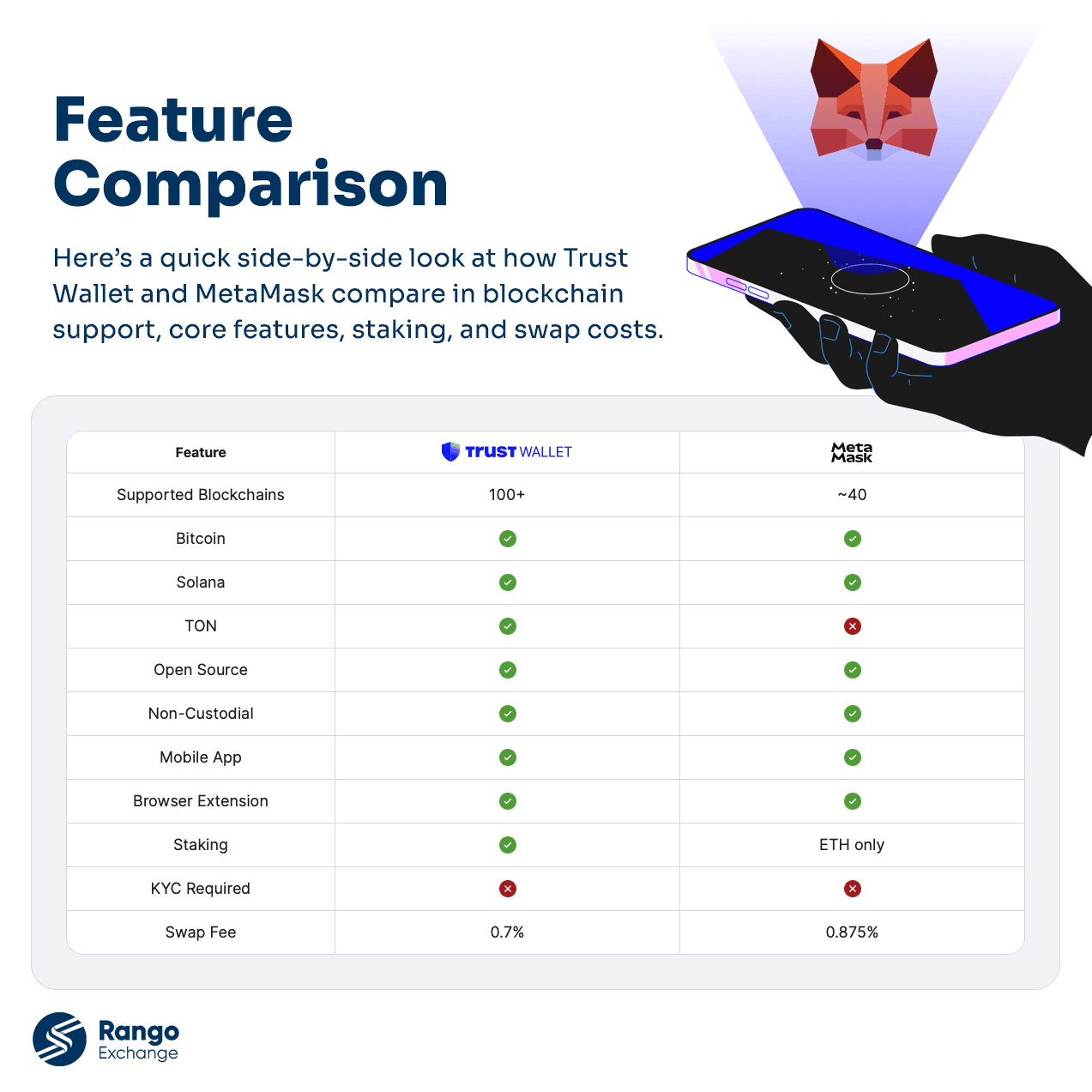
Neither wallet charges a subscription merely for holding crypto, but on-chain actions still require network fees paid to validators. MetaMask’s published swap fee structure includes a 0.875% MetaMask fee, in addition to the quoted rate and network fee. Trust Wallet’s July 2026 comparison lists a 0.7% swap fee included in the displayed exchange rate; third-party spreads, routes, and network costs may still change the final amount. The final token output should therefore be compared instead of the headline fee alone.
A small quote test is useful. The same token pair, amount, and network can be opened in both wallets, after which the minimum received and total cost can be recorded. A small test transaction may then be conducted before the main transfer. This is more reliable than assuming that either Trust Wallet or MetaMask will always be cheaper.
Is MetaMask or Trust Wallet Safer?
Both are hot wallets (software wallets used on internet-connected devices), so phishing, malicious approvals, compromised devices, and recovery-phrase exposure remain material risks. MetaMask provides transaction security alerts and broad hardware-wallet support. Trust Wallet provides a Security Scanner and local private-key encryption, although a Browser Extension v2.68 incident disclosed in December 2025 affected 2,520 addresses and approximately $8.5 million; reimbursement was announced for verified users.
That incident concerned a specific extension version and does not establish that every Trust Wallet installation is unsafe. However, it reinforces the importance of downloading wallets through verified sources, installing security updates promptly, and separating long-term holdings from wallets used for unfamiliar DApps. No software warning should be treated as a substitute for reviewing the actual transaction.
Private Keys and Wallet Security
Private keys and Secret Recovery Phrases remain under user control in both wallets. Anyone who obtains the phrase can normally recreate the wallet, while confirmed blockchain transactions cannot be reversed by wallet support. The phrase should be backed up offline, never entered into an unexpected website, and never shared with a person claiming to provide support. A separate low-value wallet may be used for unfamiliar DApps, and a hardware wallet can be reserved for long-term holdings. Token approvals should also be reviewed periodically because an approval may permit a smart contract to spend tokens after the initial interaction has ended. Before a signature is submitted, the domain, requested permission, token amount, and destination contract should be validated.
Which Is Better for You?
The answer depends on the networks used, the preferred device, and how frequently DApps are accessed. No single winner can be stated because chain coverage, signing clarity, convenience, and hardware-wallet compatibility are weighted differently.
MetaMask for Ethereum and DeFi Users
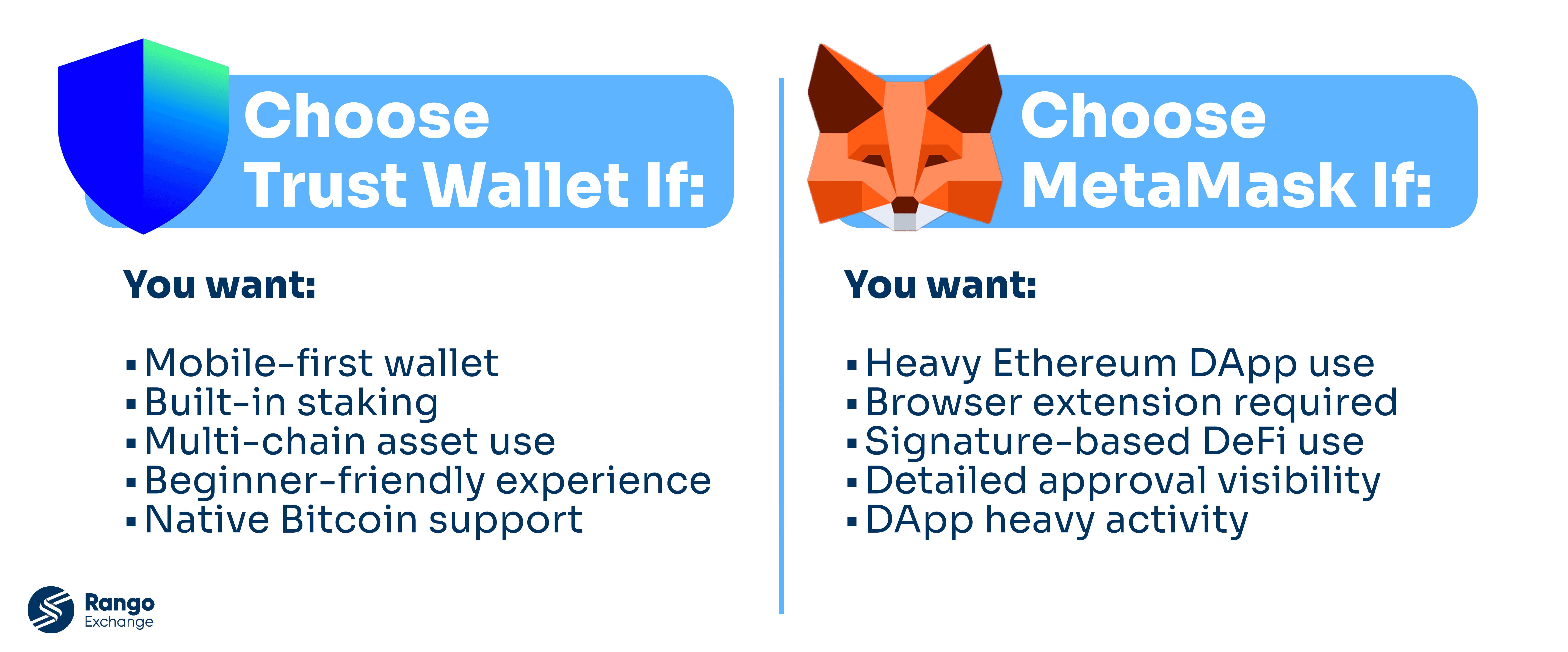
MetaMask is generally the stronger fit when Ethereum and EVM DeFi are used regularly, especially through a desktop browser. It is also suitable when custom RPC configuration, advanced gas controls, transaction alerts, and hardware-wallet integration are valued. Although native chain support has expanded, its most mature workflow remains connection and signing across EVM applications. Users who regularly interact with lending markets, liquidity pools, DEX aggregators, and on-chain bridges may find this integration depth useful.
Trust Wallet for Mobile and Multi-Chain Users
Trust Wallet is generally better suited to users who manage Bitcoin, Solana, TON, EVM tokens, and other networks from one mobile interface. Fewer manual additions are usually required, while staking and portfolio functions are presented across a broader native chain set. It may therefore be easier to use Trust Wallet when mobile asset management matters more than detailed browser-based DeFi controls.
Large transfers should still be preceded by a small test, particularly when a new network, memo, bridge, or destination address is being used. Sending a supported asset through the wrong blockchain can leave it inaccessible until a compatible recovery pathway is found.
Conclusion
MetaMask and Trust Wallet now overlap across many networks and features, but each still offers a distinct user experience. MetaMask combines multichain asset support with strong browser-based DApp connectivity, detailed transaction controls, DeFi integrations, and hardware-wallet compatibility. Trust Wallet places greater emphasis on mobile-first portfolio management, broad native network coverage, and convenient access to assets across multiple blockchain ecosystems.
The better choice depends less on a universal ranking and more on the user’s preferred devices, applications, networks, and transaction habits. Swap and bridge costs should be evaluated using the final amount received, since network fees, provider charges, slippage, and routing can all affect the actual outcome. Security also depends heavily on protecting the recovery phrase, reviewing token approvals and signing requests, installing software only from verified sources, and keeping the device secure. Before completing a large swap, bridge, or transfer, users should confirm the selected network, destination address, permissions, route, and transaction preview, then consider sending a small test transaction first.
Resources
Frequently asked questions
Check out most commonly asked questions, addressed based on community needs. Can't find what you are looking for?
Contact us, our friendly support helps!
Which Wallet Has Lower Fees?
Trust Wallet currently has the lower stated fee for its built-in swap feature. Trust Wallet lists a 0.7% swap fee, while MetaMask applies a 0.875% fee to swaps completed through MetaMask Swaps. However, these percentages do not represent the total transaction cost. Network gas fees, token liquidity, price impact, slippage, bridge fees, and third-party provider charges can affect how many tokens are ultimately received.
For example, a wallet with a lower platform fee may still return a worse price if its selected liquidity route has higher price impact. The most reliable comparison is therefore the minimum amount received shown on each transaction preview. The same token pair, network, and trade amount should be quoted in both wallets before confirmation.
Can MetaMask and Trust Wallet Be Used Together?
Yes. MetaMask and Trust Wallet can be installed and used as separate wallets on the same device. Different recovery phrases may be maintained for each wallet, and assets can be transferred between their public addresses like any other on-chain transfer. The same recovery phrase can also be imported into both wallets, allowing compatible accounts to be accessed through either interface. However, this approach increases security exposure because the recovery phrase must be entered into another application. Differences in derivation paths, the rules used to generate account addresses, may also cause some imported accounts, particularly on non-EVM networks, to appear differently or remain unavailable. MetaMask notes that imported phrases use its supported derivation paths, so complete cross-wallet compatibility should not be assumed. For most users, keeping separate recovery phrases and sending a small test transaction between the wallets is the safer and clearer setup.
Is Trust Wallet Better Than MetaMask?
Trust Wallet suits users who prioritize mobile access, broad native network support, and simple asset management across more than 100 blockchains.
MetaMask also supports multiple ecosystems, including Bitcoin, Solana, TRON, and EVM networks. Its main strengths are browser-based DApp access, DeFi integrations, detailed transaction controls, and hardware-wallet support.
Trust Wallet is generally better for mobile-first portfolio management, while MetaMask is stronger for browser-based Web3 activity and advanced transaction control.