What Are Gasless Swaps?

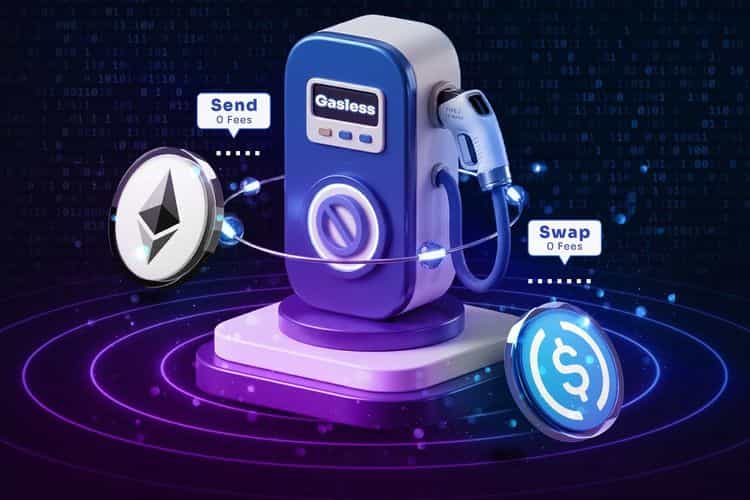
If you have ever tried to trade one crypto token for another, you may have hit a strange wall: the app tells you that you cannot move your money because you do not have enough "gas". You hold plenty of the token you want to trade, but the swap still fails. Gasless swaps remove this wall. They let you trade tokens without needing to keep a separate coin just to pay network fees. This guide explains what gasless swaps are, why they exist, and how they quietly make crypto easier to use. Read on to see how it all fits together.
TL;DR
Here is the short version before we go deeper.
What is a gasless swap?
A gasless swap is a token trade where you do not need the blockchain's native coin to pay the fee. You keep only the tokens you want to trade, and the trade still goes through.
In a normal swap, you need two things: the token you want to trade, and a small amount of the network's own coin to pay the fee. On Ethereum that coin is ETH. On BNB Chain it is BNB. A gasless swap removes the second requirement. You sign a simple message, and a helper takes care of the rest.
The important point is this: "gasless" does not mean the fee disappeared. It means the fee no longer comes out of your coin balance. The cost gets handled in the background and is taken from your trade instead. We will come back to this later, because it matters.
What is gas, in plain terms?
Gas is the fee a blockchain charges to do anything. Think of it like postage on a letter. The network is doing work for you, and gas is what you pay for that work.
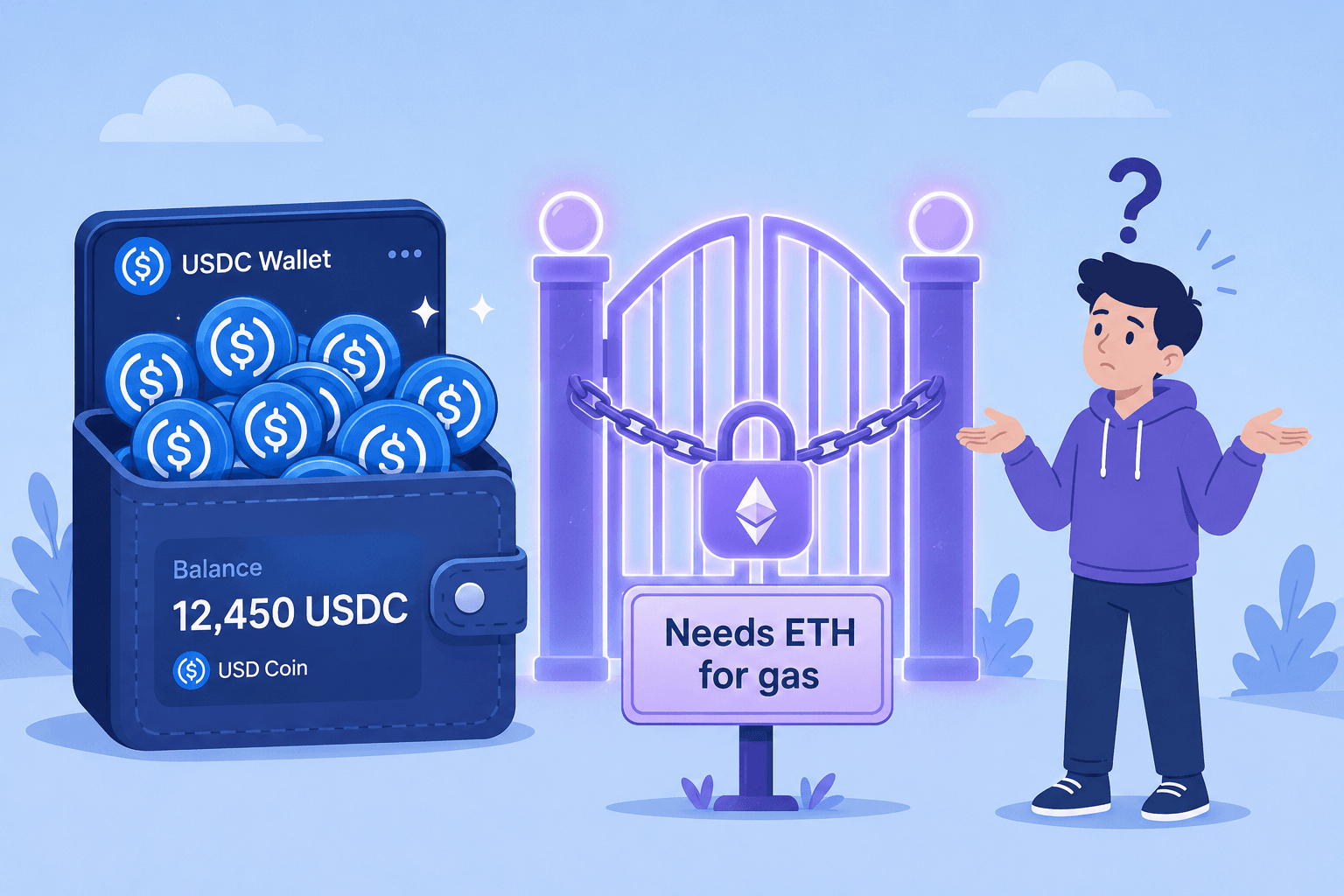
The catch is that gas can only be paid in the network's native coin. If you are on Ethereum, you must pay in ETH. This is true even if you are trading two completely different tokens, like swapping USDC for DAI. You still need ETH sitting in your wallet just to cover the fee.
This creates a frustrating situation for newcomers. Imagine someone buys their first stablecoins and wants to trade them. They cannot, because they have no ETH for gas. They are forced to leave the app, go buy ETH somewhere, wait for it to arrive, and only then come back. Many people give up at this exact moment. Studies of crypto apps have found that asking new users to buy a gas coin first can cause roughly half of them to drop off.
Why do gasless swaps matter now?
Gasless swaps matter because they remove one of the biggest reasons people quit crypto early. The fewer steps and surprises a new user faces, the more likely they are to stay.
They also help experienced users. If you spread your money across many blockchains, you normally need a little native coin on each one, just for fees. That is annoying to manage. Gasless swaps let you act on a chain even when you hold none of its coin.
There is one more reason this is timely. Crypto is moving toward a world where everyday people, not just experts, can use it. A smooth first experience is essential for that. Removing the "go buy a gas coin first" step is one of the clearest ways to make crypto feel as easy as a normal app. This connects to a bigger idea called chain abstraction, which aims to hide all the messy technical details from users.
How does a gasless swap work?
The simplest way to picture a gasless swap is to separate two jobs that normally happen together: deciding what you want, and doing the actual on-chain work.
In a regular swap, you do both yourself. You build the transaction and you pay the gas to send it. In a gasless swap, you only do the first job. You sign a message that says, in effect, "I want to trade this for that, at this price". This signature is free. It costs no gas because nothing is sent to the blockchain yet.
A helper then steps in. Depending on the app, this helper is called a solver or a relayer. The helper takes your signed message, does the actual trade on-chain, and pays the gas out of its own pocket. You receive your new tokens, and the helper gets paid back from the trade itself.
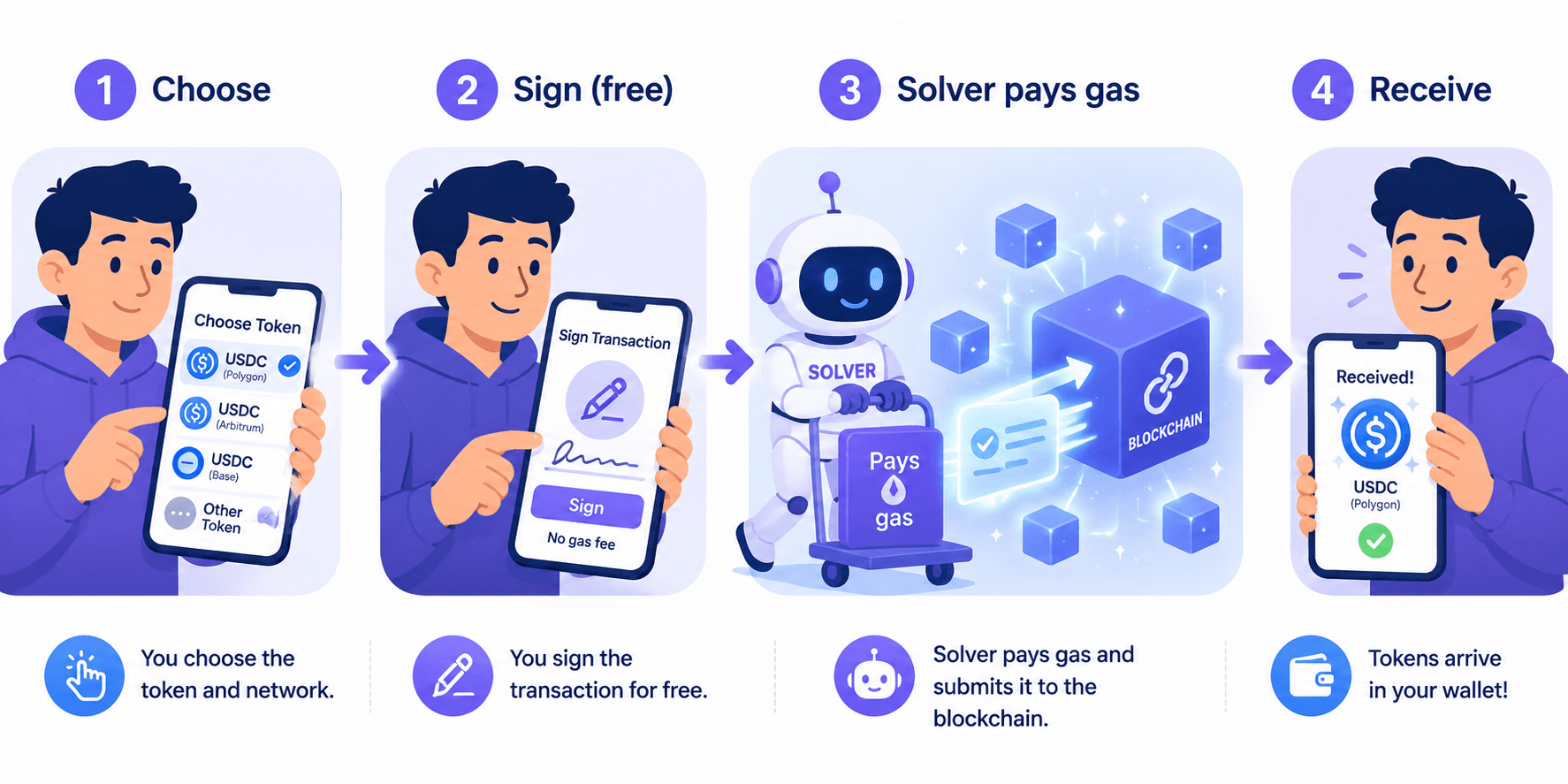
Here is the flow in four simple steps:
- You choose: You pick the tokens and amount you want to swap, just like normal.
- You sign: You approve the trade with a signature in your wallet. No gas needed, no native coin needed.
- A helper acts: A solver or relayer submits the trade to the blockchain and pays the gas fee.
- You receive: Your new tokens land in your wallet, and the helper takes its small cut from the trade.
From your side, it feels just like any other swap. You tap a few buttons and your tokens change. All the gas handling happens quietly in the background.
Are gasless swaps really free?
No, and this is the one thing every beginner should understand. The network always charges a fee, and someone always pays it. Gasless just means that someone is not you, at least not in the obvious way.
So how does the helper get paid? Usually the cost is baked into your trade. The helper takes a very small slice of the tokens moving through the swap to cover the gas it paid, plus a tiny profit. On large, popular token pairs this slice is often very small. You are essentially paying the fee in the token you are already trading, instead of in a separate coin.
This is actually good news for most users. You may pay a touch more than the raw network fee, but you save yourself the hassle of buying and managing a native coin. For many people, that trade is well worth it. The convenience is the whole point.
Which apps offer gasless swaps?
Gasless swaps are now common across many well-known crypto apps. You do not need special tools to use them. In most cases the app simply offers it as the default or as a clearly labeled option.
Some popular examples include UniswapX from Uniswap, 1inch Fusion, CoW Protocol, 0x, and others. Each works a little differently under the hood, but they share the same goal: let you trade without worrying about gas.
For cross-chain swaps, where you move from one blockchain to another, gasless becomes even more useful, because otherwise you would need native coins on both chains. We, at Rango Exchange, aggregate many bridges and exchanges and offer gasless swaps across both EVM chains and Solana, so you can move between networks without stocking up on a gas coin for each one. You can try cross-chain swaps today on Rango Exchange.
Many of these systems are built on standards that quietly made gasless possible, like gasless approvals and account abstraction. You do not need to learn these to use a gasless swap, but they are the building blocks working behind the scenes.
Are gasless swaps safe?
For the most part, yes. Your funds stay protected by the signature you give. The helper cannot change your trade, take a different token, or send your money somewhere else. If it tried, your signature would no longer be valid and the trade would simply fail.
There is one real risk worth knowing about, and it applies to all of crypto, not just gasless swaps: signature phishing. Because signing is free and feels harmless, scammers try to trick people into signing a message that secretly approves draining their wallet. The defense is simple. Only sign messages on apps you trust, and read what your wallet shows you before approving. If something looks off, stop.
The other thing to know is that a helper could, in rare cases, be slow or refuse to process your trade. That is an inconvenience, not a theft. Your money is never at risk from a lazy helper, because nothing moves without your valid signature.
Conclusion
Gasless swaps fix one of crypto's most annoying early hurdles: needing a separate coin just to pay fees. By letting you sign a simple approval while a helper handles the on-chain work, they make trading feel smooth and familiar. The fee does not vanish, it simply gets folded into your trade, which is a fair deal for the convenience. As crypto keeps working to welcome everyday users, gasless swaps are one of the clearest signs of progress.
Resources
Frequently asked questions
Check out most commonly asked questions, addressed based on community needs. Can't find what you are looking for?
Contact us, our friendly support helps!
Do I need ETH or BNB to do a gasless swap?
No. That is the whole point. You only need the tokens you want to trade. The fee is handled by a helper and paid back from the trade itself, so you do not need to keep a native coin in your wallet just for gas.
If a gasless swap fails, do I lose money?
Generally no. If the trade does not go through, you keep your tokens. In many gasless systems you also avoid paying a failed-transaction fee, since you never sent the transaction yourself. Just be careful only to sign messages on apps you trust.
How does Rango Exchange use gasless swaps?
Rango aggregates many exchanges and bridges and offers gasless swaps on both EVM chains and Solana. This is especially helpful for cross-chain trades, where you would otherwise need a native coin on every network you touch. You can try it on Rango Exchange.
Can't find what you are looking for? Contact us, our friendly support helps!