EIP-4337: Ethereum's Account Abstraction


For years, the Ethereum ecosystem has grappled with a fundamental design choice: the separation between Externally Owned Accounts (EOAs) and Smart Contract Accounts. While powerful, this duality has created significant user experience hurdles, from the terror of losing a seed phrase to the rigidity of transaction validation. EIP-4337 is not just another incremental update; it's a paradigm shift that introduces Account Abstraction (AA) to Ethereum's application layer, promising to reshape how we interact with the blockchain. This article provides a technical breakdown of EIP-4337, exploring its architecture, core components, and the powerful new capabilities it unlocks for developers and advanced users.
TL;DR
EIP-4337 implements Account Abstraction by moving logic from the core consensus protocol to a higher-level smart contract system, avoiding the need for a hard fork.
What’s Wrong with Ethereum’s Two-Account System?
Before diving into the solution, it's crucial to understand the problem. Ethereum has always had two distinct account types:
-
Externally Owned Accounts (EOAs): These are the standard accounts controlled by a private key (and by extension, a seed phrase). They can initiate transactions and pay for gas. However, their logic is fixed: a valid transaction requires only a valid ECDSA signature. This makes them simple but rigid and unforgiving. Lose your key, and your assets are gone forever.
-
Contract Accounts (Smart Contracts): These accounts are controlled by their code, deployed on the blockchain. They can have complex, arbitrary logic (e.g., a multi-sig wallet), but they are passive. A smart contract cannot initiate a transaction on its own; it must be "woken up" by a call from an EOA.
This division creates a clumsy user experience. Users are forced to manage EOAs for transaction initiation and gas payments, even when interacting with sophisticated smart contract wallets. EIP-4337 aims to merge the capabilities of both, allowing a user's primary account to be a smart contract itself.
What Is EIP-4337 and Why Does It Matter?
To fully appreciate its impact, it's helpful to understand the proposal's journey and the minds behind it.
EIP-4337: The Architecture of Change
Previous attempts at Account Abstraction, like EIP-2938, required deep changes to the Ethereum protocol itself, making them difficult to implement. The genius of EIP-4337 is that it achieves the same goal without altering the consensus layer. It builds a new, decentralized infrastructure on top of the existing protocol.
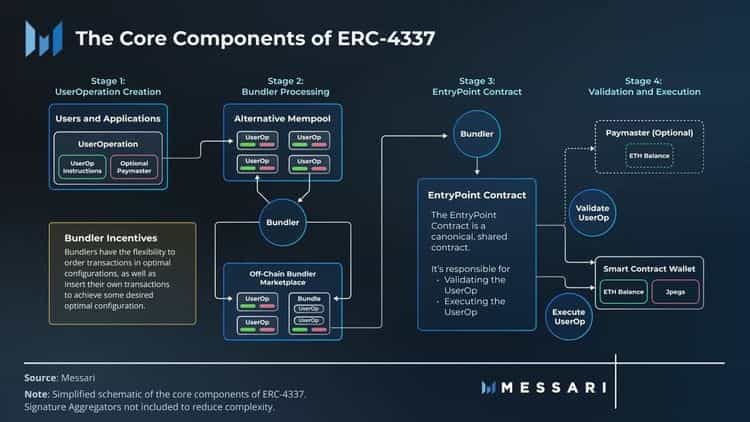
Here are the core components of this new system.
The UserOperation
Instead of a standard transaction, users of EIP-4337 compatible wallets create a UserOperation object. This is a data structure that encapsulates the user's intent. Key fields include:
This object is sent to a dedicated, off-chain mempool.
The UserOperation Mempool and Bundlers
UserOperations do not go into the standard Ethereum transaction mempool. Instead, they are routed to a separate P2P network. Listening to this network are specialized nodes called Bundlers.
A Bundler's job is to:
Bundlers are economically incentivized. They profit by collecting the fees paid by each UserOperation they include in their bundle.
The EntryPoint Contract
This is the linchpin of the entire system. The EntryPoint is a globally recognized, singleton smart contract that has been heavily audited and is trusted to be secure. The Bundler's single transaction makes one call to the EntryPoint contract's handleOps function.
The handleOps function executes a two-phase loop for the array of UserOperations it receives:
-
The Verification Loop: For each
UserOperation, theEntryPointcontract performs aCREATE2operation to calculate the sender's address if it doesn't exist yet. Then, it calls thevalidateUserOpfunction on thesender(the user's Smart Account). This function checks the signature and nonce, and ensures the account has enough funds to pay the gas fee (or that a Paymaster will pay). -
The Execution Loop: After successfully verifying an operation, the
EntryPointexecutes itscallData. This is where the actual logic happens, for instance, calling a Uniswap contract to perform a swap.
This two-part design is critical for security. It prevents a malicious contract from draining a Bundler's funds during the verification step and ensures that execution only happens after successful validation.
The Smart Account
This is the user's wallet, which is now a fully-fledged smart contract. To be EIP-4337 compliant, it must implement a specific interface, most importantly the validateUserOp function.
This is where the magic of programmability comes in. The validateUserOp logic can be anything the developer desires:
- A simple ECDSA signature check, mimicking an EOA.
- A multi-signature check requiring M-of-N signatures.
- A quantum-resistant signature scheme.
- A check against a list of trusted "session keys."
- Logic that allows a set of "guardians" to approve a recovery transaction.
The Paymaster (Optional)
The Paymaster is a contract designed to enable gas abstraction. If a UserOperation specifies a Paymaster, the EntryPoint will ask the Paymaster to pay for the transaction instead of the sender.
This unlocks several powerful use cases:
What Does EIP-4337 Do?
The technical architecture of EIP-4337 directly translates into tangible benefits for both developers and users.
Challenges and the Road Ahead
While revolutionary, EIP-4337 is not without its challenges. The system introduces a new set of actors (Bundlers), which could become a point of centralization if not sufficiently decentralized. There is also a gas overhead associated with the additional contract calls compared to a standard EOA transaction. However, ongoing developments in the ecosystem, including signature aggregation via EIP-7212, aim to mitigate these costs.
Adoption is now the key metric. With major infrastructure providers offering Bundler services and a growing number of wallets embracing smart accounts, the transition is well underway.
Conclusion
EIP-4337 represents a fundamental re-architecting of how we think about accounts on Ethereum. By moving transaction validity logic from the protocol layer to the EVM, it grants users and developers unprecedented flexibility. Now that it has reached "Final" status and is supported by a burgeoning ecosystem of infrastructure and wallets, its impact is no longer a future promise but a present reality. It abstracts away the most intimidating aspects of blockchain interaction, like seed phrases and gas management, without sacrificing decentralization. For developers, it provides a rich design space for creating more secure, user-friendly, and powerful DeFi protocols and applications. EIP-4337 is the foundation for the next generation of crypto wallets and dApps.
Resources and Further Readings
Frequently asked questions
Check out most commonly asked questions, addressed based on community needs. Can't find what you are looking for?
Contact us, our friendly support helps!
How does EIP-4337 change the long-term role of EOAs on Ethereum?
EIP-4337 doesn’t remove EOAs from the protocol, but it meaningfully shifts the ecosystem toward smart accounts as the default. Because EIP-4337 wallets can validate signatures in arbitrary ways, upgrade their logic, support social recovery, batch transactions, and pay gas with tokens, they provide a far safer and more flexible user experience than EOAs ever could. Over time, dApps, wallets, and on-ramps are likely to treat EOAs as legacy accounts, still supported but increasingly unnecessary, while smart accounts become both the secure option for power users and the intuitive onboarding path for newcomers.
What are the main risks or centralization pressures introduced by Bundlers and Paymasters?
Bundlers and Paymasters introduce new economic actors, which can create concentration if only a few large infrastructure providers serve most UserOperations. Bundlers that dominate the mempool could influence transaction ordering or fee markets, and Paymasters with large budgets could shape gas abstraction flows. However, EIP-4337 is designed to be permissionless: anyone can run a Bundler, multiple competing Paymasters can exist, and the EntryPoint contract enforces strict rules on validation and solvency. As the ecosystem expands, decentralization is expected to grow naturally through competition, open-source tooling, and marketplace-style dynamics.
How does EIP-4337 affect gas costs, network congestion, and on-chain efficiency?
Smart accounts and the EntryPoint validation flow add some overhead compared to simple EOA transactions, but they enable powerful optimizations that often outweigh the extra cost. Transaction batching reduces redundant approvals and signatures; Paymasters can abstract away gas entirely; and upcoming proposals like aggregated signatures (EIP-7212, EIP-7702) substantially shrink validation footprints. In practice, EIP-4337 spreads load across a dedicated UserOp mempool and encourages more predictable user intent handling, resulting in a net improvement to UX without meaningfully increasing congestion on the core Ethereum mempool.