
Best DeFi Yield 2026

Finding the best DeFi yield in 2026 is no longer about chasing the highest advertised APY. As decentralized finance has matured, sustainable DeFi yields have become increasingly tied to real protocol revenue, liquidity demand, and effective risk management instead of short-lived token incentives. This guide explains how modern yield farming works, what affects DeFi yield farming rates, and how today's leading protocols compare, helping you evaluate opportunities with greater confidence.
What Is DeFi Yield Farming?
DeFi yield farming is when you deposit crypto assets into decentralized finance protocols to earn more returns. Instead of sitting around in a wallet, the assets are put to work in liquidity pools, lending markets or automatic vaults where they help facilitate activity on the blockchain, and earn rewards for doing so.
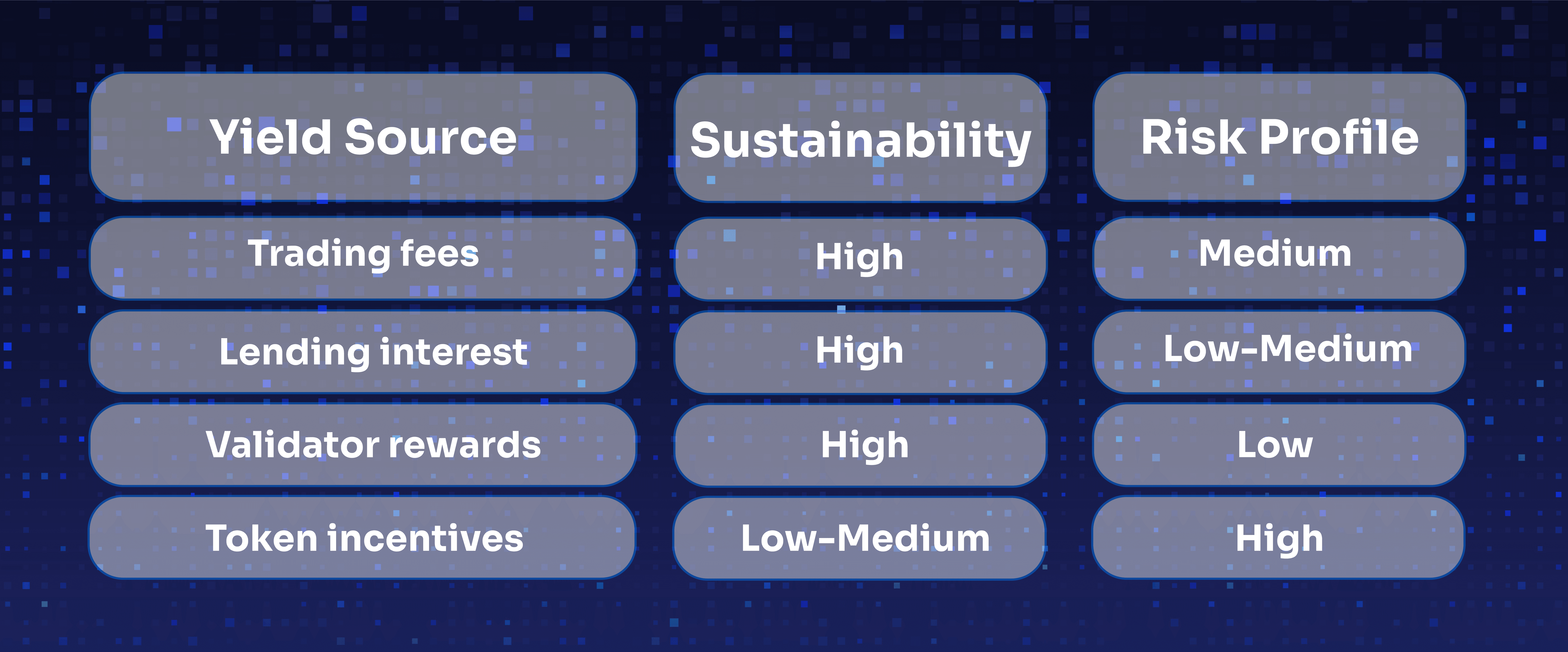
Yield farming is based on smart contracts, not financial institutions like savings accounts. Returns are typically based on trading fees, borrowing interest, validator rewards or protocol revenue, but governance token incentives can impact the overall APY.
Liquidity continues to flow on Ethereum, Arbitrum, Base, Solana, Avalanche and other ecosystems, and the opportunities are rarely limited to just one blockchain. Capital is often transferred between networks before reaching the preferred protocol, making it increasingly valuable to understand cross-chain swaps when building a multi-chain yield strategy.
How DeFi Yield Farming Differs from Staking
Both tactics generate passive income, but are meant for different purposes.
Staking is the mechanism used to secure the Proof-of-Stake blockchains, by delegating assets to validators where the rewards are mostly paid for by network issuance and transaction fees. Yield farming, on the other hand, enables decentralized applications to gain liquidity or lending capital. Farming returns are thus typically more volatile since they rely on trading activity, borrowing demand and protocol utilization, not only blockchain security.
Where DeFi Yields Actually Come From?
One of the most common misconceptions is that high APYs come up automatically. In practice, sustainable DeFi yields are built on measurable economic activity. Typically, the strongest yield sources are trading fees collected by decentralized exchanges, lending interest paid by the borrowers, staking rewards, and protocol revenue sharing. Some of the other returns could be from governance token emissions, though these incentives generally diminish as protocols mature.
This is why many experienced investors differentiate between protocol revenue-driven real yield and incentive-driven yield that is largely dependent on token emissions.
How DeFi Yield Farming Works
Yield farming reallocates idle crypto assets into protocols where they perform specific economic functions. Depending on the platform, deposited assets may facilitate token swaps, supply lending liquidity, or participate in automated investment strategies.
While the underlying mechanisms differ, most DeFi yield farming opportunities fall into three primary categories:
Liquidity Pools
Decentralized exchanges use Automated Market Makers (AMMs) to power their liquidity pools. Liquidity providers pool assets and trades can be executed instantly, rather than matching buyers and sellers with an order book. When swaps are performed, trading fees are collected and distributed to liquidity providers in proportion. The 4 key things that influence pool performance are: trading volume, depth of liquidity, fee structure and market volatility. The returns on stablecoins are generally lower but more predictable, since the range of price fluctuations is more limited.
Lending Protocols
Lending markets generate yield by allowing deposited assets to be borrowed by other users who provide collateral. Borrowers pay interest based on supply and demand, while lenders receive a share of those payments. Compared with liquidity pools, lending protocols generally eliminate impermanent loss, although yields fluctuate as utilization rates change. Protocols such as Aave and Morpho have become popular because borrowing demand tends to generate relatively stable returns for major assets and stablecoins.
Automated Yield Strategies
Managing multiple positions across different protocols can become operationally demanding. Automated vaults simplify this process by harvesting rewards, compounding returns, and periodically rebalancing positions without requiring continuous manual interaction.
These strategies are commonly offered by protocols such as Beefy and Yearn, allowing capital to remain productive while reducing repetitive on-chain transactions. Before deploying assets across several ecosystems, understanding how cross-chain liquidity is managed can significantly simplify portfolio allocation when multiple networks are involved.
What Affects DeFi Yield Farming Rates?
Not all DeFi yield farming rates are created equally. Two protocols offering similar APYs may rely on entirely different revenue models and expose users to different risks.
Evaluating yield therefore requires more than comparing percentages.
APY vs. APR
APR (Annual Percentage Rate) measures simple annual returns without accounting for compounding. APY (Annual Percentage Yield) assumes rewards are periodically reinvested. Because many DeFi protocols automatically compound rewards through vault strategies, APY generally provides a more realistic estimate of long-term returns. However, actual performance depends on changing market conditions and should not be interpreted as a guaranteed outcome.
Token Incentives vs. Real Yield
Protocols frequently distribute governance tokens to encourage liquidity growth. Although these emissions can temporarily create some of the highest APY yield farming opportunities, they often decrease over time.
Real yield is generally considered more sustainable because it is funded by protocol revenue rather than inflationary token issuance. As incentive programs expire, protocols supported by genuine trading activity or lending demand typically demonstrate greater stability.
Why TVL and Liquidity Matter?
TVL (Total Value Locked) is the sum of assets locked within a protocol. Higher TVL is usually a sign of higher market confidence and more liquidity but it doesn’t always equate to better returns.
Liquidity depth is more than yield. It also affects slippage, trading efficiency, and protocol resilience during volatile market conditions. So, a balanced evaluation should consider TVL along with historical revenue generation, security audits, and protocol adoption, rather than relying solely on APY.
Best DeFi Yield Farming Platforms Compared
No single protocol consistently delivers the best DeFi yield across every market cycle. Instead, each platform excels in different areas depending on the asset, strategy, and risk tolerance.
| Use Case | Leading Protocols | Why They Stand Out |
|---|---|---|
| Stablecoin Yield | Aave, Morpho, Curve | Strong lending demand and deep liquidity |
| Fixed Yield | Pendle | Tokenized future yield markets |
| Auto-Compounding | Beefy | Automated vault strategies across multiple chains |
| Ethereum Vaults | Yearn | Mature automated portfolio management |
| Solana Yield Farming | Kamino | Capital-efficient lending and liquidity strategies |
Best Platform for Stablecoin Yields
Stablecoin strategies remain popular because price volatility is minimized while lending demand often remains consistent. Protocols such as Aave, Morpho, and Curve have established deep liquidity, making them common choices for conservative yield farming strategies.
Best Platform for Multi-Chain Yield Farming
Yield opportunities are increasingly distributed across multiple ecosystems rather than concentrated on Ethereum alone. Efficiently moving capital between chains has therefore become an important part of portfolio management. Using a cross-chain DEX aggregator like Rango Exchange can simplify asset transfers by comparing available bridges and swap routes before funds reach the target protocol.
Best Platform for Experienced Users
Advanced participants often combine several strategies simultaneously, including leveraged lending, liquidity provision, and fixed-yield products. Pendle, Yearn, and Beefy offer greater flexibility for these approaches, although they also require a stronger understanding of protocol mechanics and risk management.
Highest APY Yield Farming: Is It Sustainable?
High APYs are often the most eye-catching but don’t often tell the full story. A yield higher than 100% may be supported by temporary token incentives and not by sustainable protocol revenues. Those returns often decline as incentive programs run out or liquidity improves.
It is usually better to look at where the yield is coming rather than just the highest percentage. Protocols that earn money from lending, trading fees or liquid staking generally offer more stable returns than those that rely mostly on governance token emissions.
A high APY should therefore be treated as a signal for further analysis rather than an investment decision on its own.
Choosing the Right Yield Farming Strategy
The best yield farming strategy depends on an investor's objectives, risk tolerance, and preferred assets. Some approaches prioritize capital preservation, while others seek higher returns by accepting additional market or protocol risk.
Stablecoin Yield Farming
One of the most accessible entry points into DeFi is yield farming with stablecoins, as it significantly reduces exposure to crypto price swings. Returns are often earned through lending protocols like Aave or Morpho, or stablecoin liquidity pools on Curve.
Although yields tend to be lower than more aggressive strategies, they have historically been more consistent in changing market conditions.
Blue-Chip Crypto Yield Farming
Big cryptocurrencies like ETH, BTC, SOL, etc. can offer extra returns through lending markets, liquid staking, or liquidity provision. The idea behind it is that long-term holders can earn passive income without having to convert their assets to stablecoins. But even if the underlying protocol works as intended, the biggest risk is still market volatility.
Auto-Compounding Vaults
Auto-compounding vaults automatically harvest and reinvest earned rewards, reducing the need for manual transactions while maximizing the effect of compounding over time.
Protocols such as Beefy and Yearn continuously optimize positions according to predefined strategies. For users managing assets across several ecosystems, these vaults can reduce operational complexity while maintaining competitive DeFi yields.
Leveraged Yield Farming
Leveraged yield farming amplifies exposure by borrowing additional assets before deploying capital into yield-generating positions. Although returns may increase when market conditions remain favorable, liquidation risk and borrowing costs rise accordingly.
This strategy is generally reserved for experienced participants who understand collateral management, liquidation thresholds, and changing interest rates.
Risks Every Yield Farmer Should Understand
Even the best yield farming platforms cannot eliminate risk. Before funds are deposited, both market and protocol risks should be evaluated alongside expected returns.
Impermanent Loss
Impermanent loss occurs when the relative prices of assets within a liquidity pool change after the deposit is made. Although trading fees may offset part of the loss, highly volatile asset pairs can underperform simply holding the assets independently.
Stablecoin pools generally experience much smaller price divergence, making them a common choice for more conservative liquidity providers.
Smart Contract Risk
Every DeFi protocol depends on smart contracts, and vulnerabilities cannot be ruled out entirely, even after multiple audits. Bugs, exploits, or unexpected contract behavior may result in partial or complete loss of deposited funds.
Before interacting with any protocol, reviewing audits, protocol documentation, and following established crypto transaction security best practices can significantly reduce avoidable operational risks.
Oracle and Bridge Risks
Many DeFi applications depend on price oracles to determine collateral values and execute liquidations. Incorrect price feeds may lead to unexpected liquidations or inaccurate protocol behavior.
Similarly, multi-chain yield farming often relies on blockchain bridges. Since bridges have historically been one of the largest attack surfaces in DeFi, selecting well-established infrastructure and verifying every transaction before confirmation remains essential.
Rug Pulls and Protocol Failures
Not every protocol survives changing market conditions. Some projects fail because of poor token economics, while others suffer governance failures, liquidity crises, or malicious developer activity.
Protocols with transparent documentation, public security audits, active governance, and sustained Total Value Locked (TVL) generally provide stronger indicators of long-term reliability than anonymous projects advertising unusually high APYs.
Best Practices Before Depositing Funds
Successful yield farming is often determined by consistent operational habits rather than selecting the highest advertised return. Before allocating significant capital, a small test transaction should be completed to verify the destination address, selected network, and expected outcome. Wallet approvals should be reviewed regularly, unnecessary token permissions should be revoked, and smart contract interactions should always be confirmed before signing.
Diversification also remains an effective risk management technique. Instead of concentrating capital in a single protocol, many experienced participants distribute funds across multiple strategies, blockchains, and asset types. This approach reduces exposure to individual protocol failures while maintaining access to a broader range of DeFi yield opportunities.
Conclusion
Finding the best DeFi yield in 2026 requires more than comparing APYs. Sustainable DeFi yields are increasingly supported by protocol revenue, lending demand, and trading activity rather than temporary token incentives. Understanding how different strategies generate returns, and how risks such as impermanent loss, smart contract vulnerabilities, and bridge security affect those returns, makes it easier to evaluate opportunities across an increasingly multi-chain ecosystem.
Rather than pursuing the highest advertised yield, successful participants typically prioritize diversified exposure, verified protocols, and consistent operational practices. Small test transactions, careful review of transaction details, and a clear understanding of where returns originate remain some of the most effective habits before capital is committed.
Resources
Frequently asked questions
Check out most commonly asked questions, addressed based on community needs. Can't find what you are looking for?
Contact us, our friendly support helps!
What is the most profitable DeFi yield strategy?
The most profitable strategy depends on market conditions and the level of risk being accepted. Leveraged yield farming and newly launched liquidity mining programs may occasionally offer the highest APYs, but these opportunities often rely on temporary token incentives and can change rapidly. For many long-term participants, strategies supported by lending interest, trading fees, or real protocol revenue have historically provided more sustainable returns than incentive-driven farms.
What is a good APY for DeFi?
A good APY should always be evaluated alongside the underlying source of the yield. Stablecoin lending typically offers lower but more sustainable returns, while volatile liquidity pools or incentive-driven farms may advertise significantly higher APYs. Rather than comparing percentages alone, it is generally more useful to determine whether the yield is supported by protocol revenue or temporary token emissions.
Can you make money with DeFi yield farming?
Yes, DeFi yield farming can generate passive income by earning trading fees, lending interest, staking rewards, or protocol revenue. However, returns are never guaranteed. Market volatility, impermanent loss, smart contract vulnerabilities, and changing liquidity conditions can all affect performance. Understanding these risks before depositing funds is just as important as comparing APYs.