ERC-7786: Cross-Chain Messaging Gateway

The multichain ecosystem is a landscape of incredible innovation, but it is also one of profound fragmentation. For developers building cross-chain applications, the environment resembles a digital Tower of Babel. Every bridging protocol, from LayerZero and Wormhole to Axelar and CCIP, speaks its own language with unique APIs, security assumptions, and message formats. This lack of standardization forces developers into a painful choice: commit to a single provider and risk vendor lock-in, or build a complex, costly, and brittle patchwork of adapters for every bridge they want to support. ERC-7786: Cross-Chain Messaging Gateway is a proposal designed to tear down these walls. It is not another bridge; it is a universal translator. This EIP proposes a standard interface for cross-chain messaging, aiming to do for interoperability what ERC-20 did for tokens: create a common language that unlocks seamless communication and composability across the entire blockchain ecosystem.
TL;DR
ERC-7786 is a proposed standard interface for cross-chain messaging. It does not introduce a new bridging protocol but provides an abstraction layer to interact with any existing bridge.
Why Are Crypto Bridges So Hard to Use?
To grasp the importance of ERC-7786, we must first appreciate the complexity it aims to solve. The current state of cross-chain communication is chaotic. Imagine you are building a cross-chain DEX aggregator that needs to source liquidity from multiple chains. To do this, you need to send messages (e.g., "swap token A for token B") between them.
Here’s the challenge:
This fragmentation creates a cascade of problems:
-
Massive Development Overhead: Integrating a single bridge is a significant undertaking. Supporting multiple bridges requires writing, testing, and maintaining a separate adapter for each one. This code is not only complex but also security-critical.
-
Vendor Lock-in: The high cost of integration incentivizes developers to choose one bridge and stick with it. This stifles competition and leaves the application at the mercy of that single provider's security, fees, and uptime.
-
Increased Security Risks: Each custom adapter is a potential attack surface. A small mistake in the implementation for one bridge can lead to a catastrophic failure. Furthermore, abstracting away the differences between bridges is a non-trivial task that can introduce its own set of bugs.
-
Poor Composability: The lack of a standard makes it difficult for cross-chain applications to interact with each other. An application built on LayerZero cannot easily compose with an application built on CCIP without yet another layer of custom logic.
This is the technical debt of the multichain world, and ERC-7786 is the proposed refactor.
What Is ERC-7786?
ERC-7786 did not emerge from a vacuum. It is the product of collective experience and pain points felt by teams building at the forefront of interoperability.
ERC-7786: Cross-Chain Messaging Gateway
ERC-7786 introduces a simple yet powerful idea: abstract the how of cross-chain messaging from the what. A developer should only need to specify what message to send and where it should go. The specific mechanics of how it gets there should be handled by a standardized component.
The best analogy is ERC-20. Before ERC-20, every new token on Ethereum was a unique smart contract. A wallet or an exchange had to write custom code to support each one. ERC-20 standardized the interface with functions like transfer(), approve(), and balanceOf(). This simple change ignited the DeFi revolution because any application could reliably interact with any token.
ERC-7786 aims to be the ERC-20 for cross-chain messages. It defines a standard interface that any bridge provider can implement in a Gateway Contract. The application developer interacts with the standard functions of the gateway, and the gateway's implementation handles the protocol-specific logic for the underlying bridge.
How Does ERC-7786 Work?
The elegance of ERC-7786 lies in its simplicity. It focuses on standardizing only the most essential components of messaging, leaving room for flexibility and innovation in the underlying protocols.
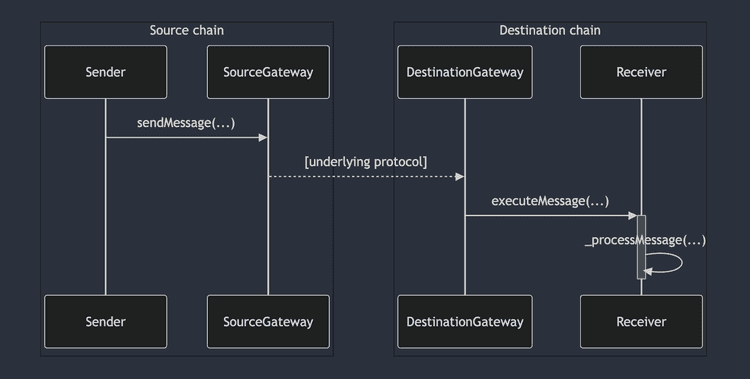
The standard is primarily composed of two interfaces: the IMessageGateway and the IMessageReceiver.
The Gateway Interface
This is the interface that dApp developers will interact with on the source chain. A bridge provider (e.g., LayerZero) would deploy a contract that implements this interface.
The core function is:
function sendMessage(
    bytes32 destinationChainId,
    address receiver,
    bytes calldata message
) external payable;
Let's break down the parameters:
The interface also mandates a standard event:
event MessageSent(
    bytes32 indexed messageId,
    bytes32 destinationChainId,
    address receiver,
    bytes message
);
This event is crucial for off-chain infrastructure. Indexers, explorers, and application front-ends can listen for MessageSent events to track the status of cross-chain transactions.
The Receiver Interface
To ensure messages are delivered in a predictable way, ERC-7786 defines an interface that any receiving contract must implement.
The core function is:
function receiveMessage(
    bytes32 sourceChainId,
    address sender,
    bytes calldata message
) external;
When the underlying bridge delivers the message on the destination chain, its gateway contract will call the receiveMessage function on the specified receiver contract.
This standard ensures that a contract is explicitly designed to handle incoming cross-chain messages, preventing accidental calls or unexpected state changes. It also requires the gateway to emit a corresponding MessageReceived event upon successful delivery.
Why Is ERC-7786 Important?
The adoption of ERC-7786 would catalyze a new wave of innovation by fundamentally altering the developer experience.
Challenges and Considerations
No standard is a silver bullet, and ERC-7786 has important nuances to consider.
Conclusion
ERC-7786 is more than just a technical proposal; it is a philosophy for the future of the internet of blockchains. It champions collaboration over fragmentation, seeking to build the foundational public infrastructure that will allow the multichain ecosystem to mature. By creating a universal language for cross-chain communication, it promises to lower barriers for developers, foster innovation in bridging technology, and ultimately create a more connected and composable secure Web3. While still a draft, ERC-7786 represents a critical step away from a collection of siloed chains and toward a truly interoperable digital world.
Resources and Further Readings
Frequently asked questions
Check out most commonly asked questions, addressed based on community needs. Can't find what you are looking for?
Contact us, our friendly support helps!
How do I practically start building a cross-chain dApp with ERC-7786?
The practical flow is to treat ERC-7786 as your single “socket” for all cross-chain logic: you wire your contracts to talk to an IERC7786GatewaySource on the origin chain and an IERC7786Recipient on the destination chain, then let gateways and adapters deal with individual bridges under the hood. In code, your app encodes the payload it wants to send, calls sendMessage on a gateway that supports ERC-7786, and implements receiveMessage on the target contract to process delivery, rather than talking to LayerZero, Axelar, Wormhole, etc. directly. You can follow OpenZeppelin’s cross-chain messaging guide to deploy gateways that plug into existing bridges and even implement patterns like a Multi-Bridge Aggregator for redundancy and better liveness.
Is ERC-7786 compatible with non-EVM chains, and how are chain IDs and addresses handled?
Yes. ERC-7786 is explicitly designed to work beyond a single EVM chain by relying on Interoperable Addresses (ERC-7930) and CAIP-350 serialization, which let you represent accounts and chains in a bridge-agnostic binary format. Instead of hard-coding address and uint256 chainId assumptions, messages carry sender and recipient as interoperable address blobs that can point to L2s, appchains, or even non-EVM environments, as long as the gateway knows how to interpret them. This means a single contract can be written against the ERC-7786 interface while different gateways handle the gnarly details of Solana vs. Cosmos vs. EVM address formats. The standard’s goal is to make “which chain is this?” a property of the message encoding and gateway implementation, not of your application code.
How does ERC-7786 fit into chain abstraction and other interoperability standards like xERC20?
ERC-7786 is one piece of the broader “chain abstraction” puzzle: it standardizes messaging, while other proposals like xERC20 focus on cross-chain tokens and fungible asset movement. In a mature stack, you might use ERC-7786 to coordinate logic (governance, state sync, cross-chain DEX routing) and xERC20-like standards to move value, all behind UX that hides which bridge or chain path was used. Projects discussing Ethereum’s “great-unity” multi-chain future see ERC-7786 as a common API that routers, aggregators, and chain-abstraction platforms can plug into, so they can compete on security and performance instead of forcing everyone into bespoke integrations. In that world, ERC-7786 becomes the universal adapter that lets chain-abstraction layers swap bridges under the hood without forcing developers to rewrite their contracts every time the interoperability meta-game shifts.