Cross-Chain DEX Aggregators vs. Traditional DEXs: Key Differences

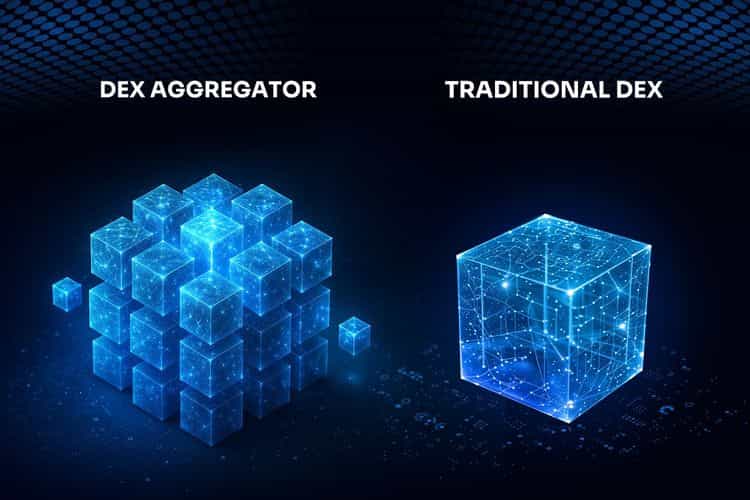
Cross-chain DEX aggregators vs traditional DEXs are increasingly compared as liquidity becomes fragmented across rollups, sidechains, and alternative L1s. It may be tempting to assume that cross-chain tools are simply “larger” versions of single-chain exchanges, yet different behaviors are observed once routing logic, risk surfaces, and recovery paths are examined. As more assets move across heterogeneous networks, differences between cross-chain and traditional DEXs begin to affect execution quality, operational workload, and failure modes. Due to these factors examining the comparison below frequently results in better-defined expectations when organizing actual trades, between chains.
What are cross-chain DEX aggregators and traditional DEXs?
Definition and core functions of traditional DEXs
Traditional DEXs (decentralized exchanges) are typically deployed as smart contracts on a single blockchain, where swaps are executed against liquidity pools or order books. Liquidity is provided by users who deposit token pairs or concentrated ranges, while pricing is determined by a formula (as in automated market makers) or by an on-chain matching engine. Under this model, trading is confined to assets native to that chain or wrapped there, so the effective universe of pairs is bounded by the traditional DEX blockchain networks it supports. In most measurements of traditional DEX vs cross-chain performance, the traditional venue is associated with lower architectural complexity, but also with stricter limits on reachable assets and routes.
How cross-chain DEX aggregators enhance decentralized trading
Cross-chain DEX aggregators are built as routing layers that sit above multiple exchanges and chains, combining DEX aggregation with bridges and messaging protocols. A single requested swap can be decomposed into several steps: a local swap, a bridge transfer, and a destination-chain swap, all selected by the aggregator’s routing engine. In practice, cross-chain DEX aggregator innovations include multi-chain path discovery, dynamic route selection based on price, speed, and reliability, and support for thousands of token pairs across dozens of chains. As a result, cross-chain DEX aggregator versatility is observed: the same interface can surface paths that would otherwise require multiple separate UIs, manual bridging, and repeated approvals.
Liquidity access and trade execution efficiency
When liquidity in cross-chain and traditional DEXs is compared, a repeated pattern is seen. A traditional DEX exposes only the pools deployed on its host chain, whereas a cross-chain DEX aggregator comparison usually reveals indirect access to many more venues and bridges. Rango, for example, has been documented to aggregate on-chain DEXs and cross-chain bridges to construct multi-step routes between assets on different blockchains. In this sense, differences between cross-chain and traditional DEXs are driven less by individual pools and more by the routing layer that combines them.
Execution quality and cost efficiency cross-chain vs traditional DEX routes depend on how this routing is performed. On a traditional DEX, a swap normally incurs a single protocol fee and one gas payment on that chain. On a cross-chain path, several legs may be involved, each with its own gas, bridge fee, and trading fee; some aggregators attempt to offset this by splitting orders optimally or batching operations. For this reason, trading fees cross-chain vs traditional DEX previews are best read carefully instead of assumed to be lower simply because more liquidity sources are referenced. Transaction speed cross-chain vs traditional DEX behavior also diverges. A single-chain trade settles once included and confirmed on that network, so latency is bounded by its block time and congestion.
By contrast, cross-chain swaps may involve confirmations on two or more chains plus bridge finality, causing end-to-end settlement to extend into tens of seconds or several minutes during peak load. In practice, a small test transaction is often conducted before the primary transfer, so that slippage, fees, and timing can be validated under current conditions. When this habit is followed, exposure to unexpected delays or partial completion is reduced.
Multi-chain interoperability and asset compatibility
Multi-chain support in cross-chain DEXs is expressed through the set of supported blockchains, bridges, and messaging systems integrated by the aggregator. Rango Exchange, for example, not only supports dozens of chains and multiple bridge providers, but also specializes in routing value across BTC-style UTXO chains in addition to EVM networks, rollups, and other non-EVM chains. This creates a multi-chain routing layer that unifies UTXO and account-based ecosystems under a single UI.
In this environment, security in cross-chain vs. traditional DEX comparisons is shaped by the additional infrastructure required for interoperability. A traditional DEX concentrates risk in its pool contracts and underlying chain consensus, while cross-chain DEX benefits are counterbalanced by risks from bridges and cross-domain messaging. Academic surveys of bridge incidents have indicated that cross-chain bridges often provide weaker security guarantees than their underlying L1s and have been a frequent target of large exploits. At the same time, modern cross-chain aggregators can significantly mitigate these risks by adding additional safety layers, independent monitoring, and human-in-the-loop review for suspicious routes or integrations. For example, Rango Exchange employs a multi-layer security model and, to date, has not been subject to a major exploit. For this reason, cross-chain vs. traditional DEX features must be evaluated not only on price and speed, but also on the reliability and security practices of each bridge, aggregator, and token representation along the route.
A typical micro-scenario illustrates this. A modest-sized swap is first routed through a cross-chain aggregator, using a well-known bridge that has publicly available audits and security documentation. Destination balances are verified on a block explorer, chain IDs and token contracts are confirmed, and only then is a larger transfer executed. In this way, cross-chain and traditional DEX integration can be combined: traditional DEXs provide depth on a single chain, while aggregators extend reach across networks once local behavior has been validated.
Advantages of using cross-chain DEX aggregators over traditional DEXs
Several advantages of cross-chain DEX aggregators over traditional DEXs are repeatedly observed in practice. Broader price discovery is achieved because liquidity can be sourced from many DEXs, aggregators, and bridges rather than a single protocol. User experience cross-chain vs traditional DEX interfaces is often perceived as simplified, since a single dashboard can initiate swaps across chains without manually configuring RPC endpoints, token lists, and bridge UIs. For portfolios already spread across multiple networks, this consolidation can reduce context switching and configuration errors.
Cross-chain vs traditional DEX features also differ in automation. Cross-chain DEX aggregator comparison tests have highlighted automatic gas-top-up on destination chains, advanced slippage controls across multiple legs, and route simulations, which are not always present in base DEX interfaces. In effect, cross-chain DEX benefits are strongest when many positions must be moved or consolidated, and when the user prefers to express intent at a higher level (source asset, destination asset, maximum slippage) rather than manually designing each hop.
Challenges and limitations of cross-chain DEX aggregators
At the same time, traditional DEX limitations are often more predictable than the failure modes introduced by cross-chain complexity. In single-chain environments, failed swaps typically revert in one transaction and are easily inspected with a block explorer. With aggregators, partial completion can occur: a bridge leg may succeed while a destination swap fails, or a message may be delayed by congestion or validator issues. The risk surface is therefore broadened, and recovery may require interaction with specialized “stuck transfer” contracts or support channels.
Traditional DEX vs cross-chain performance must also be assessed under stress. When gas spikes on any chain in a multi-leg route, or when bridge throughput is throttled, end-to-end latency can become highly variable. In these cases, clarity vs. control becomes a trade-off: the aggregator UI may present a cleaner, unified view, but internal routing details and contract calls are abstracted away. Rather than relying on users to manually manage this complexity, modern cross-chain aggregators increasingly focus on transparency and safety guarantees at the routing layer, exposing bridge choices, fee breakdowns, and status tracking. In practice, this can function as a kind of insurance: in the rare cases where funds become stuck due to bridge or routing failures, support and refund processes are used to resolve user losses and restore balances.
To sum up
Stepping back, the core differences between cross-chain DEX aggregators and traditional DEXs can be summarized along three dimensions: reach, complexity, and risk. Traditional DEXs offer narrower reach but simpler, more transparent execution paths, while cross-chain DEX aggregators extend liquidity and asset coverage at the cost of additional infrastructure and attack surface. In practice, however, mature aggregators offset part of this added risk by providing routing transparency, monitoring, and explicit support/refund processes for the rare cases where funds become stuck in bridges or intermediate contracts. Venue choice is best aligned with position size, route complexity, and the level of protection and support offered by the aggregator. A practical heuristic is to start with small, reversible tests, rely on aggregators and bridges with clear security and refund policies, verify critical steps via explorers, and only accept extra route complexity when the incremental benefit is clearly visible in the preview. In this way, cross-chain DEX aggregators can be used with measured confidence, grounded in both technical guarantees and operational safeguards.
Resources
Frequently asked questions
Check out most commonly asked questions, addressed based on community needs. Can't find what you are looking for?
Contact us, our friendly support helps!
What is the difference between a cross-chain DEX aggregator and a traditional DEX?
A traditional DEX runs on a single blockchain and lets you swap tokens that live on that chain (or wrapped there) using AMM pools or an order book. A cross-chain DEX aggregator sits on top of many DEXs and bridges, so one request can trigger multiple steps: source-chain swap, bridge, and destination-chain swap. In practice, traditional DEXs give you simpler, more transparent trades, while aggregators give you more reachable assets and routes across many chains.
When should I use a cross-chain DEX aggregator instead of a single-chain DEX?
Use a cross-chain DEX aggregator when you need to move value between different blockchains or consolidate a portfolio spread across several networks. They shine when routing through many venues can find a better overall price or when you’d rather use one interface instead of juggling bridges, RPCs, and multiple UIs. If you only need a simple swap on one chain and liquidity is good locally, a traditional DEX is usually cheaper, faster, and easier to debug.
Are cross-chain DEX aggregators safe to use? What are the main risks?
Cross-chain aggregators add bridge and messaging risk on top of normal DEX and chain risk, so the attack surface is larger than a single-chain swap. Reputable platforms like Rango Exchange help drive this effective risk close to zero by using audited aggregation layers, filtering unsafe routes, and backing users with clear refund/support processes for rare stuck-funds cases. Even so, best practice is to start with a small test trade, prefer well-audited routes, verify token contracts in explorers, and only then scale up position size.