How DeFi Coins Work?


DeFi tokens are often treated as price charts first and system components second. That ordering tends to produce confusion, because most value in DeFi is generated by mechanisms (liquidity, collateral, fees, and governance) rather than by narratives. It may be tempting to assume that “a DeFi coin” behaves like an equity proxy, yet token design is usually closer to access control, parameter steering, and incentive routing. When the underlying mechanism is understood, common behaviors, slippage, sudden APR changes, liquidations, or governance shocks, are less surprising. The full article below is intended to be read end-to-end, because the same mechanism often reappears as both a feature and a risk surface.
How Do DeFi Coins Work?
In most DeFi designs, a token is used to coordinate one of four roles: (1) governance voting in DeFi (parameter and upgrade control), (2) incentive emission (bootstrapping liquidity and usage), (3) safety backstops (loss absorption), or (4) stability mechanisms in DeFi (maintaining a target peg or rate). A practical distinction is often made between “coins” and “tokens”, but DeFi participation is usually token-centric because smart contracts are where the rules are enforced.
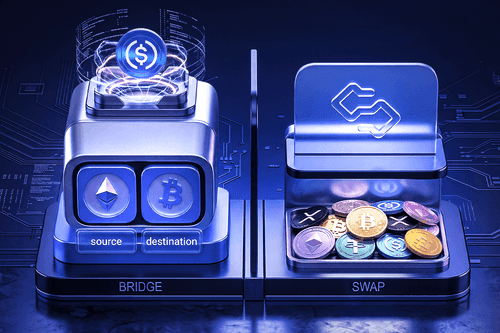
Liquidity in decentralized exchanges is commonly provided through AMMs (automated market makers), where pricing is produced by a pool’s curve and updated by trades rather than by an order book. In fragmented markets, a DEX aggregator (a routing layer that scans multiple venues and composes paths) may be used to reduce price impact and failed transactions, sometimes alongside cross-chain bridges when assets are moved between networks. That convenience is real, but additional contracts, approvals, and bridge trust assumptions are introduced with each hop.
| Project | Token role (high level) | Core mechanism | Typical failure mode |
|---|---|---|---|
| Uniswap | UNI token utility: governance and potential fee-routing controls | AMM pools + fee tiers + concentrated liquidity | Slippage/MEV; LP impermanent loss |
| Aave | aave governance role + safety backstop | Overcollateralized lending pools | Oracle/parameter risk; liquidation cascades |
| MakerDAO | makerdao governance systems (MKR) + DAI stability tooling | Vault minting + fees + liquidations + PSM | Peg drift under stress; collateral/liquidation risk |
| PancakeSwap | CAKE incentives + governance + emissions policy | AMM + farms/syrup pools + burns | Emissions/returns sensitivity; chain-specific risks |
What Does a DeFi Token Do?
DeFi tokens are basically the protocol’s control surface + incentive rails. They’re used for governance (vote the knobs: LTVs, fee tiers, listings, upgrades), emissions (bribe liquidity/usage into existence), sometimes an insurance backstop (stake it, earn yield, but you’re underwriting tail risk and can get slashed), and in stablecoin systems as peg tooling (rates/fees/collateral rules that pull the price back via arbitrage). Once you see the token as mechanism-routing, not “stock”, APR swings, slippage, and governance drama make way more sense.
How Does UNI Power DEXs?
“How Uniswap works” is best understood as a set of decentralized exchange functions centered on liquidity pools. In Uniswap v3, concentrated liquidity was introduced: liquidity is allocated inside a chosen price range, so fee earnings can become more capital-efficient but only while price remains in-range. Multiple fee tiers (commonly 0.05%, 0.30%, 1%) are supported per pair, and additional tiers can be enabled via governance. As a result, UNI liquidity pools are not a single uniform venue; they are a set of pools whose fee and liquidity geometry can differ materially by pair and tier.
UNI token economics have historically been dominated by governance rather than direct cashflow. A protocol fee “switch” exists in the design, but activation is governance-controlled and has been treated as a major policy decision; a renewed push to activate protocol fees (and route value through programmatic burns) has been discussed publicly in late 2025. Because governance outcomes can change, value-accrual assumptions are best treated as conditional rather than guaranteed.
In practice, execution quality is often determined less by branding and more by trade path selection, slippage tolerance, and MEV (maximal extractable value) exposure. A micro-scenario is illustrative: a small test swap may be executed first, the approval (token spending permission) may be limited when possible, and the previewed “minimum received” value may be checked before signing. When a DEX aggregator is used, route splitting across venues may reduce price impact, but an expanded set of contracts is typically approved and interacted with.
How Does Uniswap V3 Affect LP Returns?
V3 turns LPing into range-trading: you park liquidity in a price band to get better fee density, but you only earn while price stays in-range, once it leaves, fees drop to zero and your inventory mix shifts hard. Add multiple fee tiers per pair and liquidity gets fragmented, so outcomes hinge on tier + range selection and volatility (plus the usual MEV/slippage). In short: more efficient when you’re right, more punishing when you’re not.
How Does AAVE Governance Work?
Aave lending protocols are structured as pooled liquidity markets: suppliers deposit assets, borrowers post collateral, and interest rates are adjusted by utilization (how much of a pool is borrowed). The AAVE token is primarily used for protocol stewardship, where parameter changes (LTVs, liquidation bonuses, asset listings) and protocol upgrades in Aave are executed through a staged governance process that culminates in on-chain AIPs. Governance is not an abstract layer here; it is the mechanism by which risk controls are updated over time.
Aave protocol economics also include an explicit safety surface. Staking systems (historically the Safety Module, with newer designs layered in) have been used as a backstop, where staked assets can be slashed to cover deficits under specified conditions. This is why “yield” offered for staking is best interpreted as compensation for tail risk, not as a free add-on.
Operationally, the most common user-side failure is not an obscure exploit but a thin collateral buffer. Under volatility, liquidation thresholds can be crossed quickly, and transactions may fail or become expensive when network congestion rises. It is therefore often observed that safer outcomes are associated with conservative collateral ratios and periodic re-checking of health factors during stressed markets.
How Does MakerDAO Keep DAI Stable?
MakerDAO DAI stability is maintained through a combination of overcollateralization, pricing feeds (oracles), fees, and liquidation mechanics. DAI is minted when collateral is locked in Vaults and debt is generated against it; a Stability Fee (effectively an annualized borrowing cost) is charged and can be adjusted by governance. When collateral value falls below requirements, positions can be liquidated via auctions designed to repay the outstanding DAI debt.
Stablecoin management in DeFi also relies on peg tools that encourage arbitrage. The Peg Stability Module (PSM) has been used to allow swaps between DAI and selected stablecoins at tight spreads, which can help pull DAI back toward its target when it drifts. Separately, rates such as savings yields (where enabled) can be adjusted to influence demand for holding DAI. These levers tend to work best in normal conditions; under extreme market stress, oracle latency, liquidity gaps, and chain congestion can still create discontinuities.
Because MakerDAO governance systems ultimately steer these parameters, governance risk is not theoretical. It is usually concentrated in collateral onboarding policy, risk parameter calibration, and emergency actions, areas where incentives can be misaligned during crisis periods.
How PancakeSwap Works on BNB Chain and CAKE’s Role?
“How PancakeSwap works” is similar in structure to other AMM DEXs: swaps are executed against liquidity pools rather than matched on an order book, and liquidity providers earn fees while accepting inventory risk. PancakeSwap is historically associated with BNB Chain, where lower fees have made frequent compounding and smaller position sizes more practical than in high-fee environments.
CAKE is used across incentives and governance. Staking mechanisms such as Syrup Pools have been used to earn CAKE (or other tokens) via single-asset deposits, and governance voting power has been defined in wallet-balance terms at snapshot time under the current model. Recent CAKE Tokenomics 3.0 materials describe a deflation target (via buy-back-and-burn), emissions reductions, and retirement of prior mechanisms (including revenue sharing and veCAKE components) during 2025, meaning older mental models may not match current behavior.
As with any incentive-heavy DEX, returns are often sensitive to emissions policy, pool selection, and chain conditions. It is commonly observed that a small configuration change, such as switching pools, altering lockups, or moving liquidity to a different fee tier, can dominate outcomes more than short-term price movement.
What Are the Risks of Investing in DeFi Coins?
Risks of DeFi investments are often concentrated where irreversible actions are easiest: unlimited approvals, hurried signatures, and cross-chain transfers performed without a recovery path. DeFi smart contract risks (bugs, reentrancy, and integration flaws) remain nontrivial, and user-facing safety is also affected by transactional threats such as sandwich attacks (MEV-driven price manipulation around a swap). Safer patterns are usually associated with reading previews, keeping slippage tolerance tight, and avoiding unnecessary multi-hop routes when liquidity is sufficient in a single venue.
DeFi project challenges also include cost and operational friction. Multi-step flows, approve, swap, stake, bridge, can accumulate gas fees, and high-fee conditions can cause small positions to be structurally unprofitable even when APRs look attractive. When cross-chain bridges are introduced, an additional layer of trust assumptions (validators, liquidity networks, or custodial components, depending on design) is accepted, and bridge failures have historically been among the highest-impact events in the ecosystem.
What are the biggest DeFi risks?
Security risks are a major concern in DeFi, as users are fully responsible for protecting their wallets and interacting safely with protocols. The real danger zone is execution + permissions. Unlimited approvals turn one bad signature into a wallet-drain risk, and rushed signing means you miss what you’re actually authorizing. On swaps, MEV (especially sandwiching) punishes loose slippage and thin liquidity, your “expected price” becomes an invitation. Bridges and complex aggregator routes add extra contracts, approvals, and trust assumptions per hop, so the blast radius grows fast when something breaks. The playbook is: run a small probe trade first, cap/expiry-limit approvals, verify “min received” before signing, keep slippage tight, prefer simpler routes when liquidity is decent, and regularly revoke stale allowances.
Summery
DeFi coin mechanisms are best treated as system design choices: liquidity provision trades capital efficiency for inventory risk, lending markets trade leverage for liquidation exposure, and stablecoin designs trade capital constraints for peg resilience. UNI, AAVE, MKR/DAI, and CAKE each express these trade-offs differently, but similar operational habits tend to reduce error rates across all of them. Small, reversible tests are favored before large, irreversible actions, especially when a new contract approval or a new bridge is involved. Transaction previews should be read when exposure is nontrivial, and approvals should be reviewed periodically because old allowances can quietly persist. When returns depend heavily on emissions or governance decisions, outcomes should be framed as conditional and model drift should be expected after major upgrades or tokenomics changes.
Resources
Frequently asked questions
Check out most commonly asked questions, addressed based on community needs. Can't find what you are looking for?
Contact us, our friendly support helps!
What is the difference between a DeFi coin and a DeFi token?
A “coin” is typically native to a blockchain, while a DeFi token is issued by a dApp on top of a chain and is used for functions such as governance, incentives, or access control. In most DeFi workflows, tokens are encountered more frequently because smart contracts are the primary execution layer.
Does UNI have “cashflow,” or is it only governance?
A fee-routing mechanism exists in the protocol design, but it is governance-controlled and should be treated as policy-dependent. Governance discussions have included activating protocol fees and using fee flows for UNI burns, but outcomes depend on voting and implementation.
What are the most common risks when investing in DeFi coins?
The most common risks are typically smart contract vulnerabilities, MEV-related execution losses, liquidation events in leveraged positions, and bridge-related failures in cross-chain flows. These risks are often amplified by unlimited approvals and multi-step transactions executed without preview review.