How to Become a Blockchain Developer


It has become apparent that demand for blockchain‑centric software expertise has grown alongside rapid adoption of decentralized protocols and digital assets. A reliable pathway to enter blockchain development is therefore sought by many software professionals. Informed guidance is provided below, mapping technical prerequisites, typical roles, required skills, and an attainable progression from fundamentals to real‑world competence. The journey can be more methodically traversed when structural benchmarks are understood clearly.
What Is a Blockchain Developer?
A blockchain developer is a software developer whose professional activities center on distributed ledger technology, which can be defined as a system that is "replicated, cryptographically anchored, and consensus-enforcing" across a network of peers, absent a centralized authority. It is worth noting that a developer who specializes in blockchain development might be focused on a range of activities, including protocol logic, consensus rules, and cryptographically secured applications, also known as smart contracts, among other activities. This role differs from software development because of its immutability, decentralized trust, and token‑enabled state machines.
Types of Blockchain Developers
Core Blockchain Developer
Core blockchain developers are concerned with how the platform really works at a foundation level. They're interested in how the different consensus mechanisms, like proof of work or proof of stake, work, how to keep those mechanisms both efficient and secure, how to improve the network protocols, and how to debug problems at the peer-to-peer level. This requires a strong understanding of distributed systems, cryptographic building blocks like hash functions or signature schemes, and how to profile performance at the network edge.
Blockchain (Web3) Software Developer
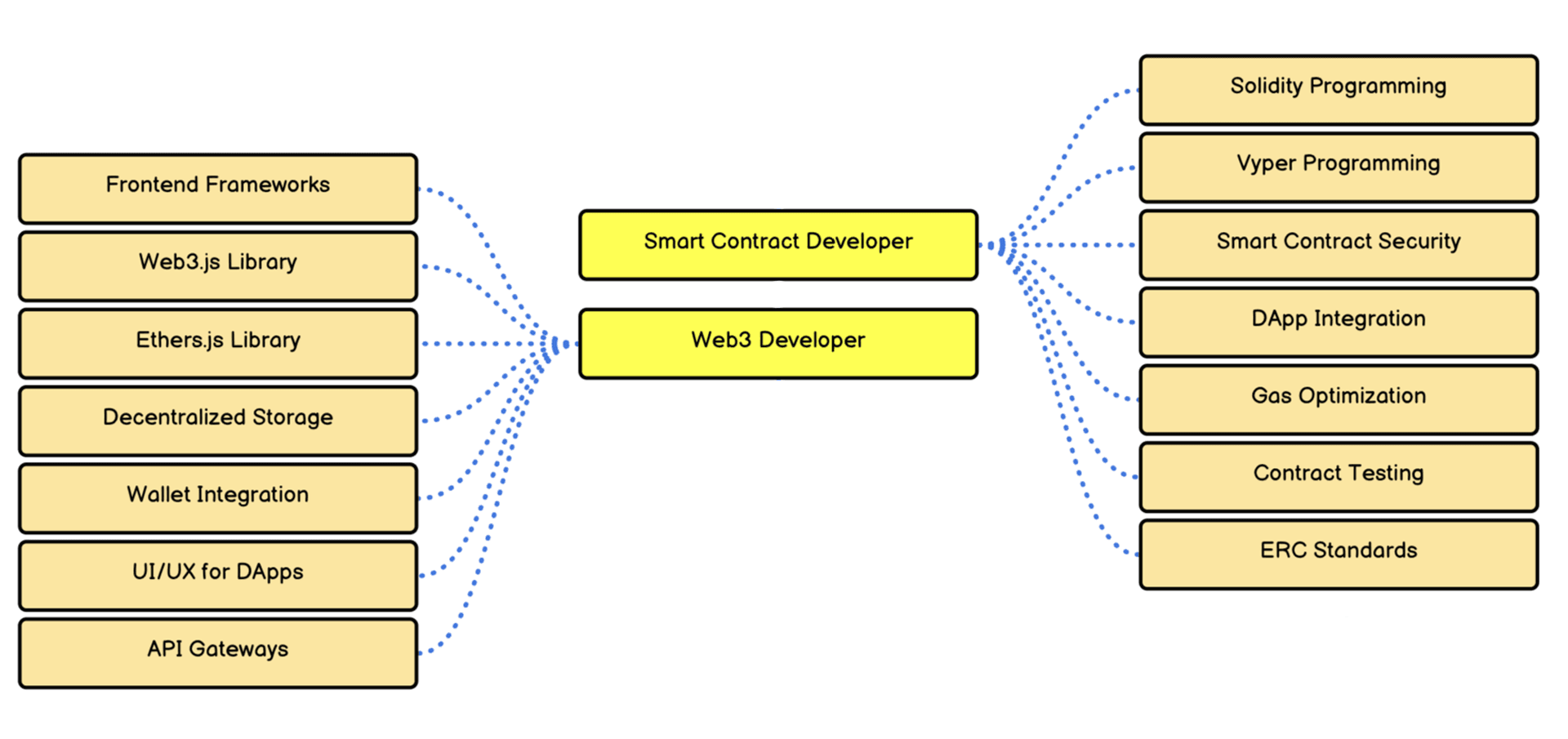
By contrast, blockchain/Web3 software developers design an app that runs on an existing distributed ledger system. Developers write smart contracts, which are self-executing programs that interact with a state tied to a blockchain, and then design a front-end interface for users and build connectors that interact with APIs or nodes. This type of development requires full-stack skills because it combines client-side code, often written in JavaScript or TypeScript, with on-chain code, often written in languages like Solidity or Rust.
Skills You Need to Become a Blockchain Developer
Programming Languages (Solidity, Rust, Python, JavaScript)
Language skills are essential from day one. In most environments, Solidity is used to power Ethereum-compatible smart contracts (a contract‑oriented language with JavaScript‑like syntax); Rust is popular for high-performance chains like Solana; and mainstream languages like Python or JavaScript are used for tooling, testing, or front-end work. In most cases, you'll want to have strong skills in at least one mainstream language and one blockchain-specific language.
Smart Contracts, Cryptography, and dApps
A smart contract is a piece of code deployed to a blockchain, running autonomously in response to certain conditions. Understanding of cryptographic building blocks (e.g., elliptic‑curve signatures, Merkle proofs) is essential because identity verification or state validation rely on these concepts. Decentralized applications, or dApps, are user interfaces that interact with smart contracts; they combine web development with blockchain interface paradigms.
Tools and Frameworks (Hardhat, Foundry, Web3.js, etc.)
Developer tools facilitate compilation, deployment, and testing of smart contracts. Tools such as Hardhat and Foundry provide staging environments with automated testing suites. Libraries such as Web3.js or Ethers.js abstract remote procedure calls (RPC) to blockchain nodes. Integration with local simulators (e.g., ganache or anvil) allows changes to be verified before live deployment.
Step‑by‑Step Roadmap to Learn Blockchain Development
Step 1: Learn Programming and Computer Science Basics
Before blockchain‑specific work is attempted, familiarity with fundamental software development principles is essential. Typical knowledge domains include data structures, algorithms, networking basics, and asynchronous I/O. Many blockchain concepts derive from distributed systems properties, so prior exposure to concurrency and fault tolerance is beneficial.
Step 2: Understand Blockchain Fundamentals
Basic blockchain concepts such as blocks, transactions, consensus, immutability, and state transition functions are often introduced in architectural discussions and whitepapers (e.g., Bitcoin and Ethereum specifications). An accurate mental model of how blocks are produced, verified, and agreed upon underpins all subsequent development.
Step 3: Build Smart Contracts and Web3 Projects
Pragmatic learning involves hands-on construction of smart contracts. Beginner contracts (for example, simple token standards) are frequently used to illustrate event emission, state mutation, and failure modes. After basic contracts are mastered, integration with front‑end interfaces and wallet providers (e.g., via RPC endpoints served by nodes or endpoints like Infura/Alchemy) is a common next step. Local testnets are used to validate behavior under simulated conditions.
Step 4: Get Real Experience (Open Source, Hackathons, Freelance)
Exposure to larger codebases and collaboration methodologies drives competency development faster. With open-source projects, one can learn from existing codebases (usually hosted on GitHub or similar platforms), while contributions can be made by patching the code or responding to issues raised. Hackathons expose one to real-world constraints while working on projects. Freelance projects emphasize the importance of specifications, deadlines, and test cases.
Best Resources to Learn Blockchain Development
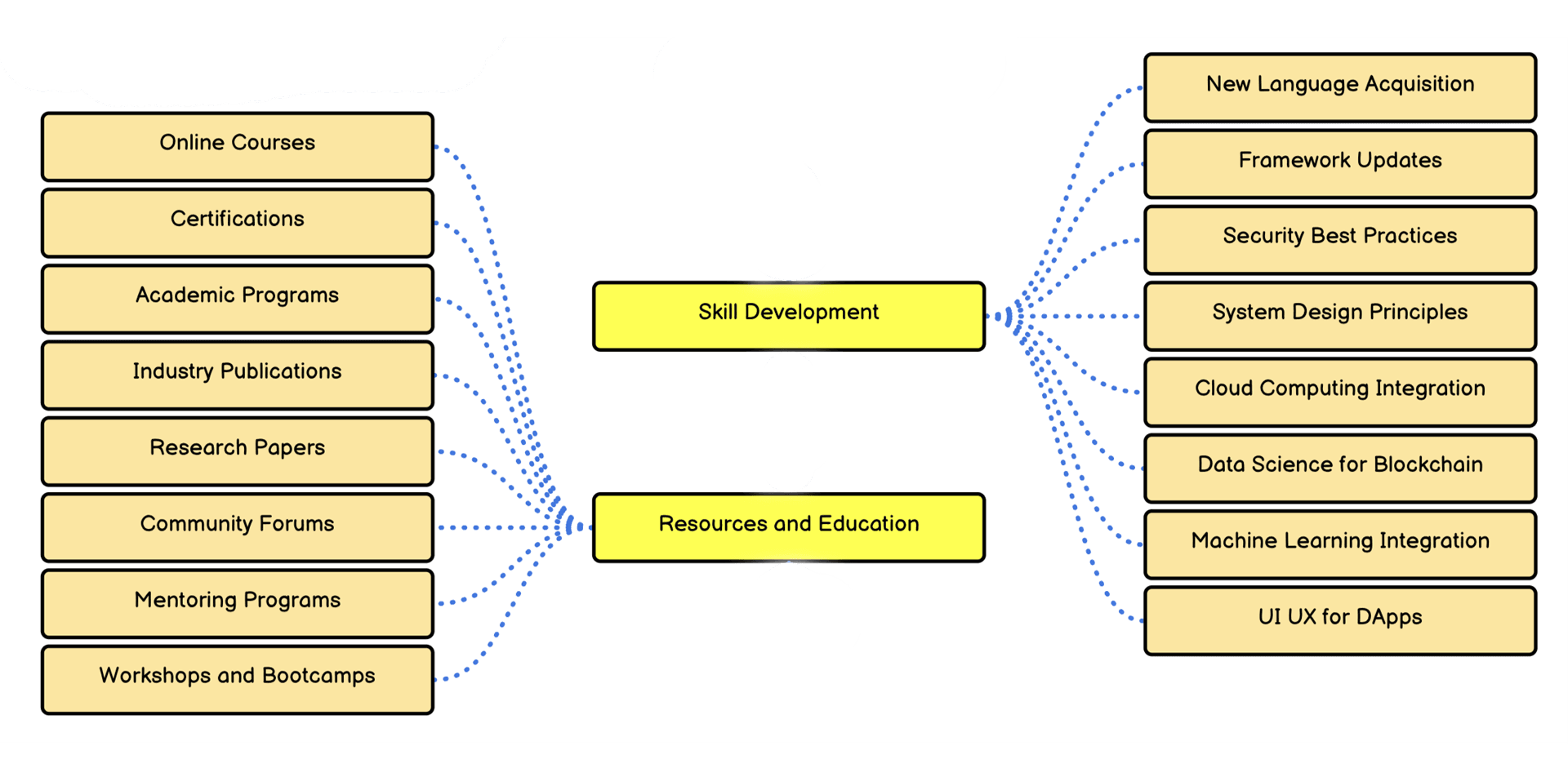
Structured courses may offer specific training in blockchain protocols and toolsets. They may also include assignments that involve smart contract development and testnet interaction. Bootcamps may offer mentorship as part of the project work.
Books on distributed systems, cryptography, and blockchain architecture may help to clarify complex concepts. Books on specific toolsets and technologies, such as the Ethereum Virtual Machine, may offer additional layers of understanding.
Peer networks may offer significant advantages in solving problems. Forums, chat groups, and specialized channels (on Discord, Telegram, or Stack Exchange) allow questions about errors, version mismatches, and design choices to be discussed with practitioners.
How Long Does It Take to Become a Blockchain Developer?
The time required to reach employable competence varies with background. For individuals already strong in software engineering, a rough estimate ranging from 3 to 9 months of focused study has been observed in structured programs. For those newer to programming, foundational study may extend the timeline. Depth of mastery also influences duration: a basic understanding sufficient for entry‑level roles may be achieved more quickly than the expertise needed for core protocol development.
Blockchain Developer Salary and Career Outlook
The salary range for blockchain developers varies based on geographic location, experience and domain focus (protocol vs dApp). With the demand for specific skill sets in the market, the compensation package tends to be above average compared to similar software development positions. The scope of remote work and freelancing tends to be common due to the decentralized nature of blockchain. However, it should be noted that while listing the salaries, they may not reflect the actual conditions.
Summary: Your Blockchain Developer Roadmap
The process of becoming a blockchain developer was outlined, from the basics of programming principles to the development of blockchain protocol and the application of smart contracts in the real world. The differences between core and application development are highlighted as a guide for choosing a speciality. Practical tips such as iterative testing, local simulation before live deployment, and community engagement, are highlighted as a way of reducing the risks involved while learning the skill. The use of a measured approach that is guided by study and experiential feedback is highlighted as an approach that can be used for learning the skill of blockchain technology.
Resources
Frequently asked questions
Check out most commonly asked questions, addressed based on community needs. Can't find what you are looking for?
Contact us, our friendly support helps!
How long does it take to become a blockchain developer?
It was observed that entry-level blockchain developer proficiency can be achieved in 6–12 months with structured learning, while advanced protocol-level expertise may require multiple years of distributed systems experience.
What is the blockchain developer salary range?
Public reports indicate that blockchain developer salary ranges are typically higher than general software engineering roles, with variability depending on geography, specialization, and market conditions. (Coursera and industry reports are commonly cited.)
Do I need a degree to become a blockchain developer?
A formal degree is not strictly required, although computer science fundamentals are strongly recommended. In practice, portfolios, GitHub contributions, and practical audits are frequently evaluated during interviews.