
Who Accepts Bitcoin Payments in 2026?

Bitcoin is easier to spend in 2026, but the meaning of “acceptance” varies by payment method. Some merchants receive BTC directly, while others rely on crypto payment processors, the Lightning Network, crypto cards, or gift-card services. A 2025 study cited by Crypto.com identified more than 15,000 businesses accepting cryptocurrency worldwide, including at least 8,000 that supported Bitcoin payments. The sections below clarify how each route works, where Bitcoin can be used, and the trade-offs associated with each option.
How to Make Purchases With Bitcoin?
A Bitcoin payment is usually started by scanning a QR code or opening a payment link in a wallet. The asset, network, amount, address, fee, and invoice expiry should be checked before approval. The exact BTC amount generated by the checkout should be sent rather than a manually estimated fiat equivalent.
Pay Directly From a Bitcoin Wallet
An on-chain Bitcoin wallet payment is broadcast to the network and may remain pending until the merchant’s confirmation requirement is met. Confirmation requirements may be increased for higher-value purchases. A small test may be conducted first when the invoice supports multiple payments.
Pay Through the Bitcoin Lightning Network
The Lightning Network is a layer-2 payment system, meaning a payment layer built above Bitcoin. Transactions are routed through off-chain payment channels and may be completed in milliseconds to seconds, generally with lower fees than standard on-chain transfers. Wallet compatibility, invoice expiry, and available payment-channel liquidity should still be checked.
Use a Crypto Card
A crypto card converts Bitcoin into local currency before or during a Visa or Mastercard transaction. The merchant generally receives fiat and does not need to accept cryptocurrency directly. Conversion spreads, card fees, issuer limits, custody arrangements, and regional availability should be reviewed before funds are loaded.
Crypto gift cards provide indirect access to stores that accept only conventional payments. Bitrefill states that more than 5,000 gift cards can be purchased with Bitcoin, Lightning, and other supported assets. Currency, account region, expiry, and redemption restrictions should be confirmed before payment is completed.
Where Can You Spend Bitcoin?
Current options are found across technology, travel, entertainment, and local commerce. Direct Bitcoin checkout should be distinguished from processor-based and gift-card access.
| Category | Verified Examples | Payment Route |
|---|---|---|
| Technology | Newegg and Namecheap | BitPay, BTCPay, or wallet checkout |
| Travel | Travala and selected Virgin Voyages products | Crypto checkout |
| Entertainment | AMC Theatres | BitPay online |
| Local and Broad Retail | Eligible Square sellers and Bitrefill brands | Lightning or gift cards |
Technology and Online Services
Newegg lists Bitcoin and other cryptocurrencies through BitPay, while Namecheap supports Bitcoin for account funding. These are clearer examples of companies that accept Bitcoin than retailers reached only through a crypto card. Availability may still differ by product, country, or checkout channel.
Travel and Tourism
Travala accepts Bitcoin among more than 100 traditional and cryptocurrency payment methods and provides access to more than 2.2 million hotels. Virgin Voyages has also accepted Bitcoin for its annual-pass cruise product. Invoice expiry, cancellation rules, and the currency used for refunds should be checked before a booking is confirmed.
Food and Everyday Essentials
Direct acceptance remains inconsistent across restaurants, supermarkets, fuel stations, and pharmacies. Crypto cards and gift cards are therefore used more often for everyday purchases. Eligible US Square sellers can also accept Lightning payments and receive settlement in BTC or USD, subject to eligibility and regional restrictions.
Retail, Gaming, and Entertainment
AMC allows online purchases through BitPay, including payments made with Bitcoin. Gaming credit, subscriptions, app-store balances, and retailer vouchers can also be purchased through Bitrefill. Those retailers should be described as indirectly accessible when only a third-party voucher is being bought.
How to Use Bitcoin With Businesses That Don’t Accept Cryptocurrency?
Pay With a Crypto Card
A crypto card can be used at merchants connected to existing Visa or Mastercard networks, even when cryptocurrency is not accepted directly. At checkout, the required amount is usually converted from Bitcoin or another supported asset into local fiat currency, after which the merchant receives a standard card payment. This removes the need for a dedicated crypto checkout and makes the method suitable for everyday purchases, subscriptions, travel bookings, and physical point-of-sale transactions.
The main trade-off is that settlement is handled by an intermediary rather than directly on-chain. Conversion spreads, card fees, ATM limits, regional restrictions, and identity-verification requirements may therefore apply. In some cases, funds must be transferred into a custodial card balance before they can be spent, which reduces direct control over the assets. The exchange rate shown by the card issuer should be reviewed before confirmation, especially when Bitcoin volatility is high or a large purchase is being made.
Buy Merchant Gift Cards With Bitcoin
Bitcoin can also be used to purchase digital gift cards for retailers that do not support crypto payments at checkout. A gift card is normally bought through a third-party platform, delivered as a code, and then redeemed directly with the selected merchant. This method can be useful for online shopping, food delivery, gaming, travel, mobile credit, and other services where direct Bitcoin acceptance is unavailable.
Before payment is completed, the gift card’s currency, country, denomination, expiration policy, and redemption conditions should be checked carefully. Some cards can only be used on regional versions of a retailer’s website, while others may exclude subscriptions, marketplace sellers, or partial redemptions. Refunds are also commonly returned as store credit rather than Bitcoin, and a completed BTC payment cannot usually be reversed by the sender. For unfamiliar providers or high-value purchases, a lower-value card can be tested before a larger amount is committed.
Convert Bitcoin to Stablecoins or Fiat
Bitcoin may be converted into fiat currency or into a stablecoin, which is a crypto asset designed to track the value of a fiat currency such as the US dollar. Fiat conversion is generally used when funds must be withdrawn to a bank account or spent through conventional payment rails. Stablecoin conversion may be preferred when value is intended to remain on-chain while exposure to short-term Bitcoin price movements is reduced.
A cross-chain DEX and bridge aggregator such as Rango Exchange can be used to compare available swap and bridge routes across supported networks. The quoted output, price impact, slippage tolerance, network fees, bridge fees, estimated execution time, and destination chain should all be reviewed before a route is approved. A small test transaction is often appropriate when a new token, network, or bridge is being used.
Native Bitcoin should not be sent directly to an Ethereum-style address. When BTC is required on another blockchain, a supported cross-chain route or a wrapped representation of Bitcoin must be used. Wrapped assets introduce additional smart-contract, custody, liquidity, and depegging risks, so the token contract and receiving network should be verified before the transaction is signed. Tax consequences may also arise when Bitcoin is sold or exchanged, depending on the user’s jurisdiction.
Pros and Cons of Different Bitcoin Payment Options
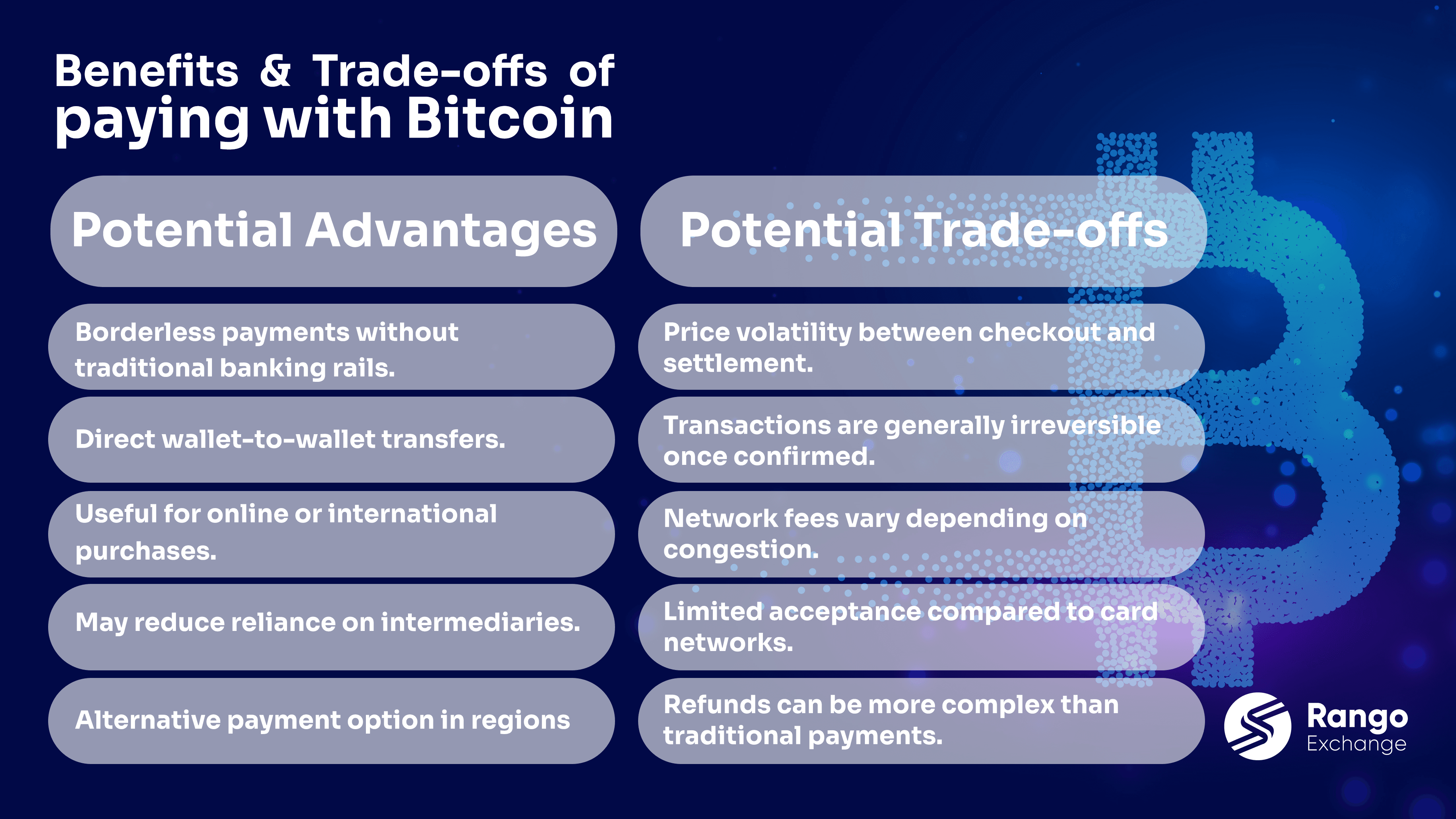
Direct wallet payments offer the most control but require careful checks of fees, confirmation times, addresses, and refund policies. Lightning is usually faster and cheaper, though wallet support, invoice expiry, and channel liquidity can affect reliability.
Crypto cards provide the widest merchant coverage but may involve identity checks, conversion fees, spending limits, and custodial risk. Gift cards are useful for unsupported stores, although regional restrictions and non-refundable codes reduce flexibility.
In practice, wallet payments favor control, Lightning favors speed, crypto cards favor convenience, and gift cards favor broader access.
How Safe Is It to Pay With Bitcoin?
Bitcoin payments can be technically secure while remaining operationally unforgiving. Confirmed transactions cannot be canceled by the sender; a refund must be issued by the recipient. Transactions are also recorded publicly, so Bitcoin should not be treated as fully anonymous.
What Should You Know Before Paying With Bitcoin?
Before a Bitcoin payment is approved, the merchant’s domain, BTC amount, selected network, destination address, transaction fee, invoice expiry, and refund terms should be reviewed. The full receiving address should be checked rather than relying only on the first and last characters, since malicious addresses can be made to appear similar. The quoted amount should also be confirmed before the invoice expires, as a price change may cause an underpayment or require a new invoice.
The merchant’s confirmation policy should be understood as well. Some purchases may be accepted after one network confirmation, while higher-value transactions may require several. Because Bitcoin payments are irreversible, a small test transaction can be useful for unfamiliar merchants or large transfers, provided the invoice supports partial payments. Recoverable wallet backups should also be created and verified before meaningful balances are stored.
How to Avoid Common Crypto Payment Mistakes?
Seed phrases, private keys, and wallet recovery files should never be entered on merchant websites or shared with customer-support representatives. Legitimate businesses do not need these credentials to receive a payment or process a refund. Unsolicited payment links, urgent requests, copied addresses from transaction history, and unexpected QR codes should therefore be treated cautiously.
Address-poisoning risk can be reduced by checking the entire destination address against the merchant’s invoice. The selected network must also match the receiving address, since sending native Bitcoin to an incompatible chain may result in permanent loss. When fees rise sharply, a payment remains pending, or an invoice is close to expiring, the transaction should not be rushed. A new invoice should be requested, and the payment status should be confirmed before a second attempt is made.
Why Businesses Accept Bitcoin and Other Crypto Payments?
Bitcoin and crypto payments may be adopted to:
· Reach crypto-native and international customers. · Support global transactions outside local card networks. · Reduce exposure to fraudulent card chargebacks. · Receive settlement in BTC, stablecoins, or local currency.
Refunds, compliance, accounting, volatility management, and customer support must still be handled. A crypto payment gateway can lock an exchange rate for the checkout period and settle the merchant in a preferred currency, reducing part of this operational burden.
Conclusion
Who accepts Bitcoin payments in 2026 depends on the payment route being counted. Newegg, Namecheap, Travala, AMC, selected Virgin Voyages products, eligible Square sellers, and smaller merchants provide verified Bitcoin checkout options, while crypto cards and gift cards extend access to unsupported stores. Direct wallet payments preserve more control, Lightning is suited to smaller and time-sensitive payments, cards maximize merchant coverage, and gift cards fill remaining gaps. Before BTC is sent, the invoice, network, address, fee, refund rules, and possible tax consequences should be reviewed.
Resources
Frequently asked questions
Check out most commonly asked questions, addressed based on community needs. Can't find what you are looking for?
Contact us, our friendly support helps!
What major companies accept Bitcoin payments in 2026?
Verified examples include Newegg, Namecheap, Travala, AMC Theatres, selected Virgin Voyages products, and eligible Square merchants. Processing may occur through BitPay, BTCPay, Lightning, or another payment provider rather than through direct BTC custody by the merchant.
How Can You Spend Bitcoin When a Merchant Does Not Accept It Directly?
Bitcoin can still be used through a crypto card, a merchant gift card, or by converting BTC into fiat or a supported stablecoin. Crypto cards provide the broadest merchant coverage, while gift cards can be useful for specific retailers and online services. Conversion fees, card limits, regional restrictions, and tax implications should be reviewed before payment.
Can Bitcoin be used for everyday purchases?
Yes. Direct wallet or Lightning payments are available at some merchants, while crypto cards and gift cards are more commonly used for groceries, restaurants, fuel, subscriptions, and other everyday spending. Availability remains dependent on the provider, merchant, and country.