Top On-chain Analysis Data Sources

On-chain analysis has become more central as liquidity has fragmented across venues, activity has shifted between L1s and L2s, and market narratives have increasingly been validated (or invalidated) by observable transaction behavior. It may be tempting to treat on-chain data as inherently objective; however, different data models, attribution methods, and labeling coverage can lead to materially different conclusions. More reliable on-chain data insights are usually produced when a platform’s methodology is understood, its scope is matched to the question being asked, and outputs are validated through small, reversible checks. The five platforms below are often selected as baseline blockchain data sources because they cover distinct “jobs” in an analysis workflow, from macro network health to wallet-level behavioral traces.
1. Glassnode
Glassnode is commonly used when “network-wide” questions are being evaluated and when historical context is required for interpretation. Metrics such as realized value, long/short-term holder dynamics, and supply distribution are often surfaced in a way that supports regime comparisons across cycles. It should be noted that many series are transformed (for example, through smoothing windows), so parameter choices can influence perceived turning points. In practice, a second confirmation is often performed by checking whether the same signal persists across adjacent timeframes or related metrics, rather than treating a single chart as decisive.

The One Metric Traders Use to Spot Cycle Extremes
The most-asked Glassnode capability is MVRV (Market Value to Realized Value), often via MVRV Z-Score, because it compresses “where are we in the cycle?” into a single valuation framework (over/undervaluation relative to realized value) that traders use to contextualize tops/bottoms. Realized-value tooling (especially Realized Cap / Realized Price) is the natural companion, since it anchors analysis to an estimated investor cost basis (coins valued at the price they last moved). In practice, users commonly pair MVRV with SOPR to sanity-check whether the market is realizing profits or losses when coins move, rather than treating any single chart as decisive.
2. Dune Analytics
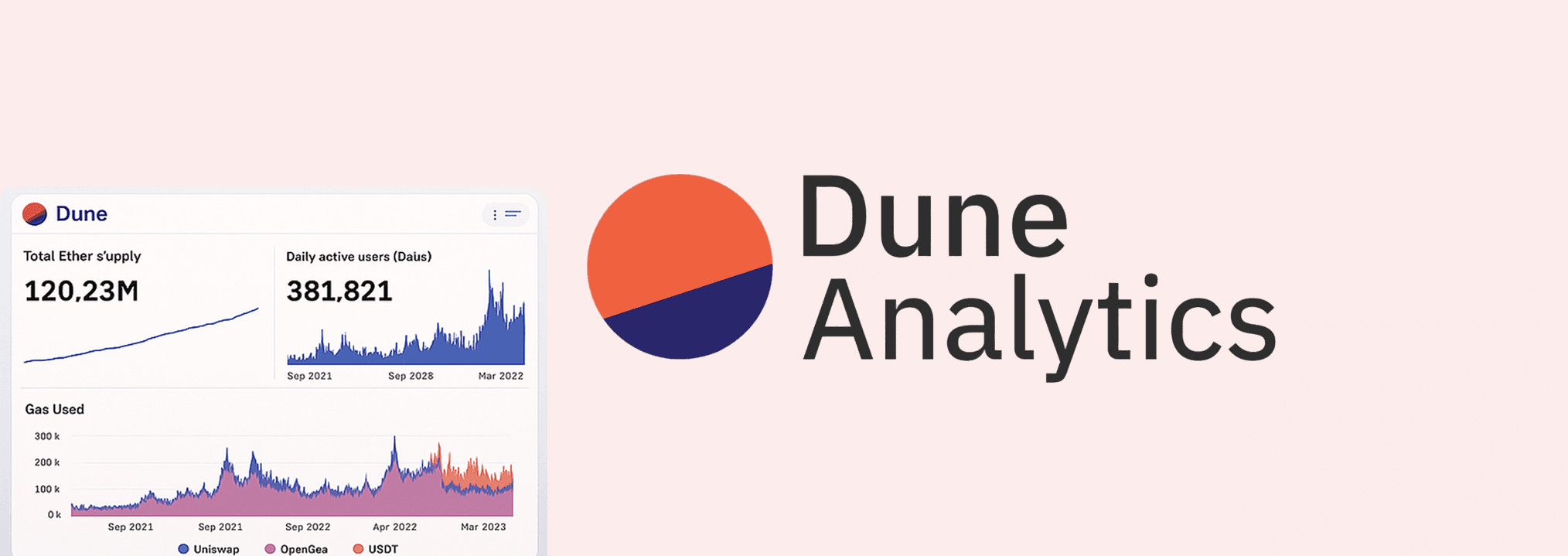
Dune Analytics is typically relied upon when custom questions must be answered directly from raw on-chain event data. Dashboards can be built by querying indexed blockchain tables, allowing protocol-specific KPIs (fees, user cohorts, retention, bridge flows) to be reconstructed and shared. Because queries are authored by humans, consistency can be degraded by schema changes, incomplete decoding, or unhandled edge cases (such as contract upgrades). For higher confidence, queries are often reviewed for address coverage, chain selection, and time-bucketing logic, and results are compared against an independent data source when the decision impact is nontrivial.
How Do You Turn Raw Onchain Data into Real KPIs?
The most-asked Dune capability is writing DuneSQL queries and turning them into dashboards, either from scratch or by forking existing community queries/dashboards, so teams can reconstruct protocol KPIs (fees, users, cohorts, retention, bridge flows) directly from indexed onchain tables and publish a single, shareable source of truth. To make this practical, users also frequently lean on Spellbook (curated/abstracted tables) to avoid re-deriving common transformations from raw/decoded data every time. For production workflows, another common request is the API, executing saved queries programmatically and retrieving results to embed dashboards or automate reporting.
3. CryptoQuant
CryptoQuant is frequently selected when exchange-linked flows and market-adjacent indicators are being monitored. Inflows/outflows, reserve estimates, miner-related series, and derivatives context are commonly presented in an operational format that supports alerting and routine checks. It should be expected that exchange attribution and wallet clustering can be imperfect, especially when new deposit addresses are rotated or when custodial structures change. A cautious habit is often applied: a spike is first verified by confirming that it persists across adjacent aggregations (hourly vs daily) and that it is not explained by internal wallet shuffles that can mimic genuine flow.
How Do Exchange Flows Reflect Market Liquidity?
These terms on CryptoQuant are most effective as early-warning signals for changes in market liquidity and participant intent. Exchange reserves track the aggregate balance held by known exchange wallets, while netflow isolates the balance change driven by deposits versus withdrawals over a given period. Persistent net inflows and rising reserves tend to indicate growing sell-side optionality or hedging activity, whereas sustained net outflows and falling reserves are more consistent with accumulation, self-custody migration, or long-term holding behavior. Because exchange wallet attribution and internal shuffling can distort short-term readings, these alerts are best interpreted using rolling averages, confirmation across adjacent timeframes, and confluence with price and derivatives data to separate meaningful positioning shifts from operational noise.
4. Nansen
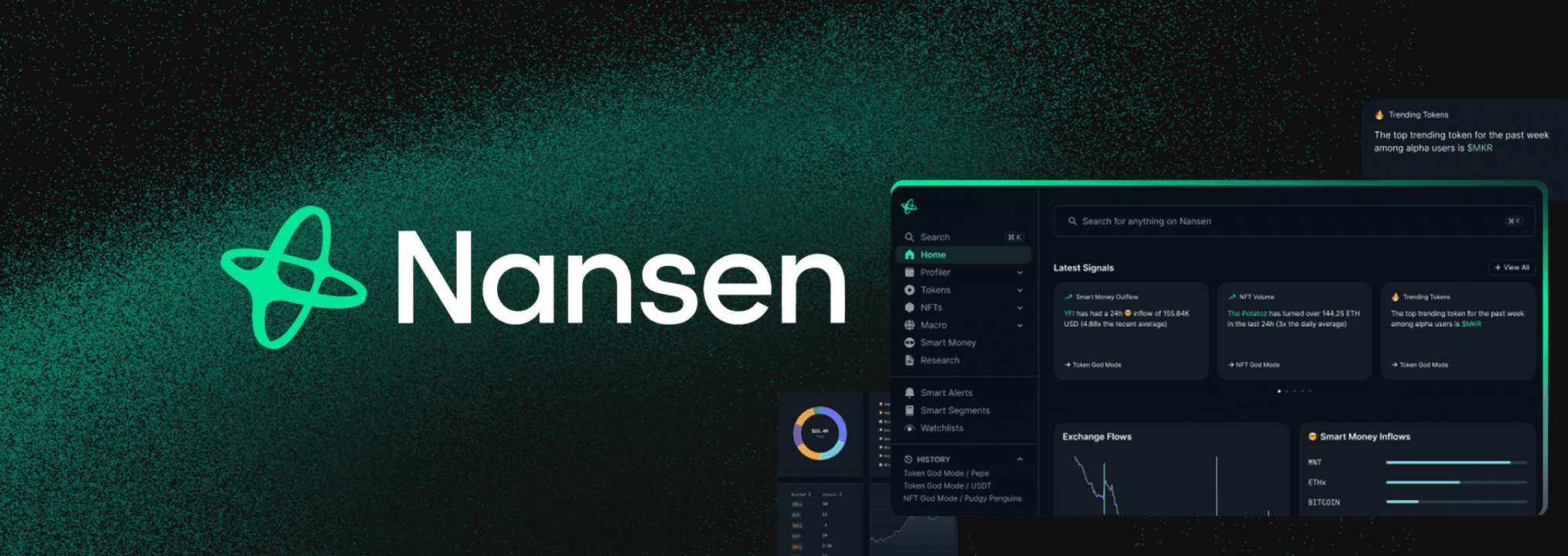
Nansen is often used when address-level labeling and behavioral segmentation are needed, particularly for tracking “smart money” narratives or entity-driven flows. Labeled wallets, token holdings, and activity streams can be helpful when a hypothesis depends on who is interacting with a protocol, not just how much activity occurred. Label coverage is not uniform across chains and sectors, so blind spots can remain even when interfaces appear comprehensive. A micro-scenario is commonly run for validation: a small set of known reference addresses is checked first to see how they are labeled and whether recent transactions are classified in the expected direction before wider inferences are made.
What Is Smart Money, and How Is It Tracked?
Nansen’s most-requested capability is Smart Money tracking, using its Smart Money Dashboard to identify historically profitable wallets, see what they’re buying/holding, and monitor capital rotation in near real time. Because Nansen pairs this with large-scale wallet labeling, you can move from “a wallet bought” to “which type of actor bought” (funds, whales, insiders, exchanges, etc.) and quickly test whether a “smart money” narrative is actually supported by onchain behavior. A common workflow is: spot Smart Money token activity in the dashboard, then drill into the token and wallets with tools like Token God Mode / Profiler to confirm accumulation, holder distribution, and related flows before drawing broader conclusions.
5. IntoTheBlock
IntoTheBlock is often used as a bridge between raw on-chain measures and interpretable market indicators, with emphasis placed on supply/in-out-of-the-money breakdowns, holder composition, and signal-style summaries. It can be useful when a quick “state estimate” is required and when multiple metrics must be reconciled without building a bespoke pipeline. However, indicator-like outputs can be over-trusted if methodology and thresholds are not inspected. More robust use is usually achieved when the underlying components are reviewed and when signals are treated as context, not as trade instructions.
How Does Cost-Basis Distribution Shape Price Levels?
IntoTheBlock’s most-asked feature is its In/Out of the Money profitability view، especially IOMAP (In/Out of the Money Around Price)، because it maps where holders’ cost basis clusters sit relative to current price and highlights areas that often behave like near-term support and resistance. Under the hood, this is an address-level profitability framework (GIOM as the broader view; IOMAP as the “near price” zoom) that classifies addresses as in/at/out of the money based on an estimated average cost.
How to choose the best source for on-chain analysis
Selection is most reliably performed by first clarifying the analysis target: network health, protocol traction, exchange-driven supply movement, or entity-level behavior. If macro cyclic structure is being studied, historical breadth and consistent definitions are often prioritized, which tends to favor platforms that publish methodology and maintain long backfills. If protocol analytics is the goal, queryability and transparency of the transformation layer are usually more important than prebuilt charts, which makes a warehouse-like environment valuable. When wallet attribution is essential, labeling depth and refresh cadence become the binding constraints, and gaps are often handled by corroborating with multiple labeling sources.
Comparison
A simple comparison can be kept in view to prevent category errors:
| need being served (workflow order) | typical best fit | what to validate first |
|---|---|---|
| cycle context / long history (macro regime framing) | glassnode | metric definition; smoothing/windowing |
| custom protocol kpis (protocol fundamentals) | dune analytics | query logic; schema changes; decoding completeness |
| exchange flow monitoring (venue-side supply/demand) | cryptoquant | attribution changes; internal shuffles vs real flows |
| entity / wallet behavior (who is doing what) | nansen | label coverage; chain scope; recency of labels |
| interpretable indicator views (signal packaging) | intotheblock | threshold assumptions; indicator components |
Operational safeguards tend to matter more than platform choice once a baseline is established. A small, reversible test is often favored before a large, irreversible decision is made: a signal is checked on a shorter timeframe, compared against an adjacent metric, and reconciled with off-chain context (order-book liquidity, funding, macro news) to reduce false certainty. Terminology should also be normalized early: “on-chain” is usually meant to describe data written to a chain (transactions, events, state), while “off-chain” data is typically venue- or service-derived (order books, KYC’d entity reports, API-provided custody labels). Confusion between these domains is frequently responsible for mismatched conclusions.
Conclusion
Reliable on-chain data insights are usually produced through method-aware reading rather than through the accumulation of dashboards. It is often found that the same market story can be “supported” by multiple metrics unless a clear question is posed and a small set of validation checks is applied. Glassnode tends to be used when cycle-scale context is required, Dune Analytics when custom questions must be answered from raw tables, CryptoQuant when exchange-linked movements are being monitored, Nansen when labeled wallet behavior matters, and IntoTheBlock when interpretability and rapid state summaries are preferred. No single platform can be treated as universally best; instead, a pairing strategy is often adopted, where one source is used for signal generation and another for confirmation. Small, repeatable verification habits are typically what keep on-chain analysis accurate under changing market structure.
Sources
Frequently asked questions
Check out most commonly asked questions, addressed based on community needs. Can't find what you are looking for?
Contact us, our friendly support helps!
What is the best crypto research tool for beginners?
A “best” crypto research tool is hard to define without a specific goal, but beginners are usually best served by platforms that prioritize clarity, education, and progressive depth, many tools are popular because they clearly explain metrics, offer historical price and market data, and provide basic fundamentals without overwhelming users. An ideal beginner tool should combine simple dashboards, plain-language explanations of concepts like market cap and token supply, and easy access to project descriptions, while still allowing users to gradually explore more advanced data such as on-chain metrics, governance details, or comparative analysis as their understanding grows.
How can smart money movements in crypto be tracked?
Smart money movements in crypto are typically tracked by first identifying and labeling wallets associated with experienced traders, funds, exchanges, or large holders through entity clustering techniques, then monitoring how assets flow between these entities over time. Analysts combine on-chain data such as transaction size, timing, token accumulation or distribution patterns, interactions with DeFi protocols, and exchange inflows/outflows to infer intent and conviction, often supplementing this with behavioral signals like early participation in new protocols or consistent profitability across cycles. Because wallet identities are inferred rather than absolute, these insights are treated as probabilistic signals rather than guarantees, making smart money tracking most useful when combined with broader market context and risk management.
Are free crypto research tools sufficient for in-depth analysis?
Free crypto research tools can be sufficient for certain types of in-depth analysis, especially when the focus is narrow or exploratory, such as tracking basic on-chain activity, monitoring token metrics, or validating a specific hypothesis. However, they often fall short for sustained or institutional-grade research due to limitations in historical data depth, wallet labeling accuracy, API rate limits, advanced querying, and the ability to fully reproduce and audit methodologies. As analysis becomes more complex or time-sensitive, paid tools or custom data pipelines are typically needed to ensure consistency, scalability, and higher confidence in the conclusions drawn.